USAID. BUR. FOR PROGRAM AND POLICY COORDINATION
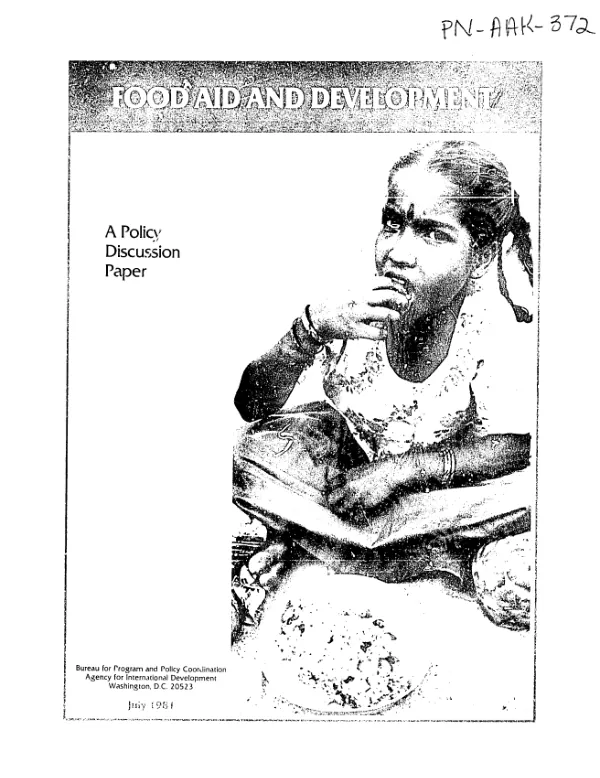
Food aid and development : a policy discussion paper
Food aid (FA) can have a positive, long-term impact on development only in the context of a broadly-based agricultural development strategy aimed at providing equity to poor farmers.
McClelland, Donald G. · 1981
Sign in to readA free account is required to download.
Abstract
Against a background discussion of this principle, this paper discusses measures that need to be examined to ensure that FA will in fact complement such an equitable growth strategy and sets forth corresponding program implications for A.I.D. Specific measures discussed are agricultural production incentives; market interventions by the government; agricultural price stabilization; food reserves; and direct food distribution. The following conclusions are offered as a point of departure for analyzing the development utility of FA in any particular country: (1) sell concessionally procured foodgrains at or near the domestic price in order to generate revenues for development and avoid undercutting private grain sales, thus discouraging domestic production; (2) mitigate the disincentive effect of large, unsubsidized programs by macroeconomic policies which encourage private investment and by investing in labor-intensive activities which employ low-income people with a high potential demand for food; (3) sell subsidized FA only to the poor; (4) encourage the use of commodities which self-target the poor, especially those that can be produced in the host country (even in the event such commodities are not available under P.L. 480); (5) decide, along with the host government, on activities in which to invest revenue generated by the sale of FA commodities, with priority given to expanding agricultural production and increasing employment; (6) when concessional FA is needed, direct the local currency generated, the foreign exchange saved, and the FA itself to assist development efforts; (7) provide technical and financial assistance to improve inadequate host country administrative and analytical capability in designing sound development activities (especially in the public sector) using the local currency generated by FA programs; and (8) in countries where U.S. FA levels are high, make sure the host country and donors are aware of alternative policy options recommended in various food and agricultural analyses or have such analyses carried out by USAID"s.
Related documents