USAID. BUR. FOR SCIENCE AND TECHNOLOGY. OFC. OF NUTRITION
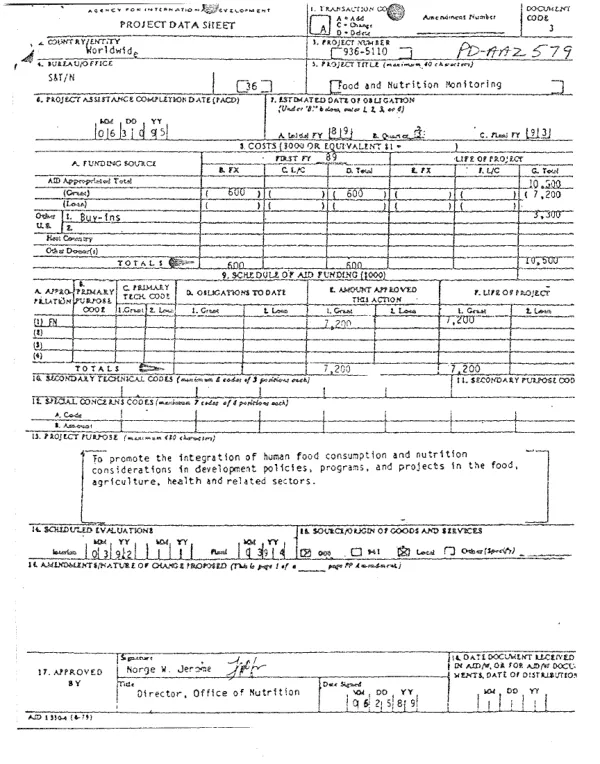
Food and nutrition monitoring
Project to integrate food consumption and nutrition considerations into development policies and sectoral activities in targeted Third World countries through TA, training, applied research, and information dissemination/networking.
1989
Sign in to readA free account is required to download.
Abstract
The project, to be implemented by a contractor, brings activities from predecessor projects 931-1064, -1171, -1274, and -1275 together into a comprehensive whole. The project will provide long- and short-term TA to help to establish/strengthen food and nutrition monitoring systems and to apply these systems to broader policy and planning analyses. TA will focus on assessing the nutritional status and dietary quality of populations, improving data collection and analysis, and developing monitoring systems that include nutrition indicators. Such monitoring systems can be applied to several types of programs -- those directly concerned with nutrition (including emergency feeding), those that indirectly affect nutritional status, and those that use nutritional status as one measure of success. Short-term TA will also be available for such activities as sectoral project design, implementation, and evaluation, analysis of family food practices and consumption patterns, and supplemental feeding programs. To ensure the capacity of cooperating countries to regularly conduct nutrition monitoring, the project will provide training in nutritional assessment, program evaluation, and analysis of the policy implications of food/nutrition monitoring data. At the policy level, project training will focus on the linkages between national food production and food availability at the household level. The training will be provided in-country and regionally, and will benefit both policy-level and operational personnel (including data technicians). The project will conduct applied research in two areas. (1) To develop new indicators of household food security and nutritional status, the project will first analyze lessons learned from the predecessor projects, and will then examine the potential usefulness of three types of indicators identified during nutritional assessments of refugees (i.e., leading, concurrent, and trailing indicators). (2) The project will also sponsor operational research, primarily rapid community assessments, on concurrent indicators. Topics will include food sources, food storage, food preferences, seasonality, and frequency of eating. The project"s experiences and findings will be disseminated via seminars, workshops, and various publications including newsletters and state-of-the-art studies. Amendment of 1/6/90 extends project to 6/96; adds a Project Development and Support (PD&S) component to fund short-term contracts for project/program design, development, evaluation, studies, and implementation support; and, accordingly, changes the project title from "Food and Nutrition Monitoring" to "Food, Nutrition Monitoring and Support". (PD-ABA-723) Grant (6/10/93) to the International Food Policy Research Institute (IFPRI) to help its sister centers in the Consultative Group on International Agricultural Research (CGIAR) to identify key research needs in the area of production-consumption-nutrition-health linkages for micronutrients. IFPRI will conduct studies to: (1) identify high-priority micronutrients (in addition to vitamin A, iron, and iodine) on a country-specific basis; (2) identify key factors that determine household demand for high-priority micronutrients; (3) determine how the CGIAR system could allocate its resources to increase the consumption of high-priority micronutrients; and (4) determine the optimal combination of CGIAR investments and national policies (e.g., relating to agricultural research, food fortification and supplementation, nutrition education, price and trade policies, and investments in infrastructure and health and sanitation services) for reducing micronutrient deficiencies. (PD-ABL-123)
Related documents