USAID. BUR. FOR PROGRAM AND POLICY COORDINATION. CENTER FOR DEVELOPMENT INFORMATION AND EVALUATION (CDIE)
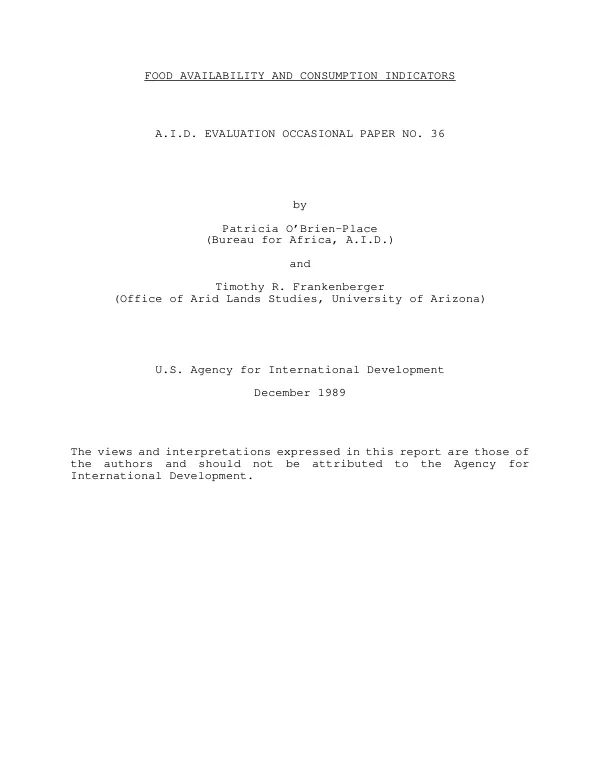
Food availability and consumption indicators
Food availability and consumption indicators can be obtained through methods varying from time-consuming, detailed analysis to rapid data collection involving rough approximations.
O"Brien-Place, Patricia; Frankenberger, Timothy R. · 1989
Sign in to readA free account is required to download.
Abstract
This report looks at food availability and consumption indicators, focusing on both direct (e.g., budget surveys, minimal data sets) and indirect (e.g., household food availability, nutritional status) indices. These data can be used to design agricultural and rural development projects, choose a target population or appropriate interventions, or monitor and evaluate project results. National food and agricultural planning also relies on food consumption data for knowledge of the nutritional and food consumption status of the population and for forecasting future food consumption needs. The document concludes that government policies from foreign exchange rates to fertilizer subsidies have an eventual impact on food consumption, making food consumption data a vital part of estimating the effects of present and proposed policies. Three appendices detail food consumption considerations in the design of agricultural projects, data categories for dietary assessment, and secondary data sources for food and nutrition status indicators. Includes bibliography (1970-88).
Connected topics
Related documents