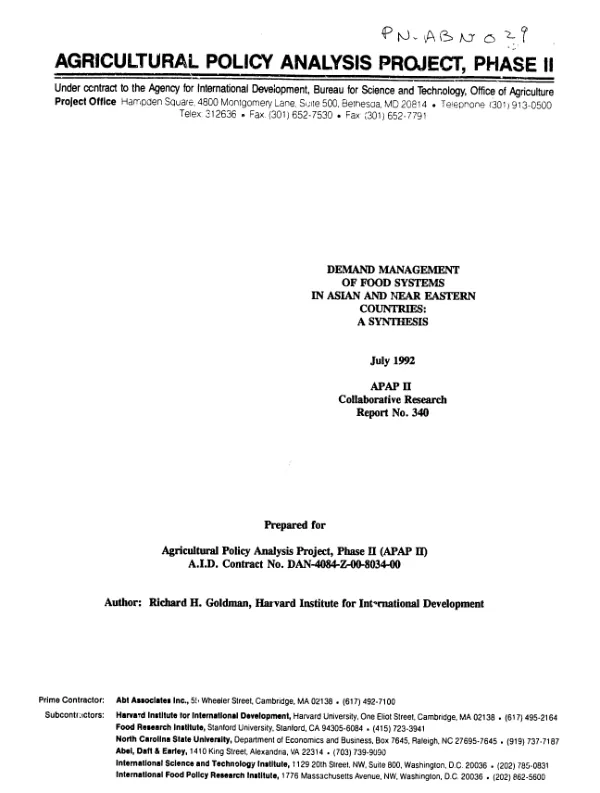
ABT ASSOCIATES, INC.
Food demand management in India
Food policy and demand management in India have had four objectives: (1) increased physical access to food via attainment of self-sufficiency in food production, (2) increased economic access to food via price stability, (3) avoidance of famines, and (4) improved food intake and nutrition for the poor and the vulnerable sections of society.
Deolalikar, Anil · 1991
Sign in to readA free account is required to download.
Abstract
This paper suggests that, while demand management policies in India have been very successful in achieving the first three objectives, they have not been effective in accomplishing the fourth goal. For instance, with a skillful combination of technology and price policy, Indian policymakers have succeeded in assuring increased physical and economic access to food to the bulk of the population. Although the per-capita availability of pulses has decreased during the last three decades, there has been a small but steady increase in the per-capita net availability of cereals in the country. Further, National Sample Survey data do not confirm a decline in the per-capita consumption of edible pulses. Most importantly, there is a great deal of evidence that indicates a very rapid increase, especially during the last decade, in the per-capita availability and consumption of foods other than grains -- foods such as milk, edible oils, and sugar. Such diversification in the diet could not have been possible without fulfillment of demand for basic cereals and foodgrains. Indian food demand management has been highly successful in another important dimension, viz., the avoidance of famines. Although conditions were ripe for widespread famine during the severe drought years of 1965-67, 1973-75, and 1987-89, famine was avoided by prompt famine relief public works programs, government"s buffer stocks, and mobilization of extra grain supplies from abroad. Indeed, emergency relief and food-for-work programs have become a permanent feature of the government"s poverty alleviation program. The avoidance of widespread famines is a major achievement of Indian food policy, especially in light of the fact that famines have occurred in Sub-Saharan Africa during the 1970"s and early 1980"s with downward fluctuations in domestic foodgrains production that were proportionately much smaller than India has experienced. Indian food demand management has failed in improving food intake and nutrition for the poor and the vulnerable sections of society. The Public Distribution System (PDS) in India is a large, expensive, poorly targeted and inefficient food subsidy scheme. With the exception of a few states, in which rural coverage is wide, the PDS primarily serves the urban middle-class. Vulnerable groups in many states do not have any access to PDS supplies. In such a situation, the PDS is likely to actually have an adverse effect on the poor, since the scheme, because of its large procurement needs, drives open-market prices for foodgrains above the levels at which they would have been in the absence of the PDS. However, the experience of a few states, such as Kerala, Tamil Nadu, and Gujarat, which have successfully managed to target the PDS to the urban and the rural poor, suggests that targeting access to the poor is administratively possible and financially feasible. (Author abstract)