USAID DEC
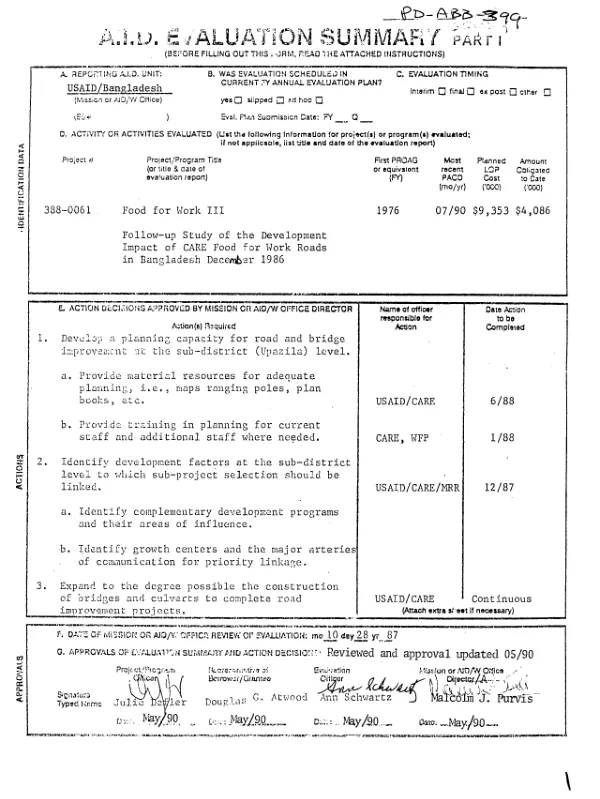
Food for Work III : institutional assessment of Food for Work and feeder roads programs in Bangladesh, May 1987
Sign inUSAID. MISSION TO BANGLADESH
Food for Work III : institutional assessment of Food for Work and feeder roads programs in Bangladesh, May 1987
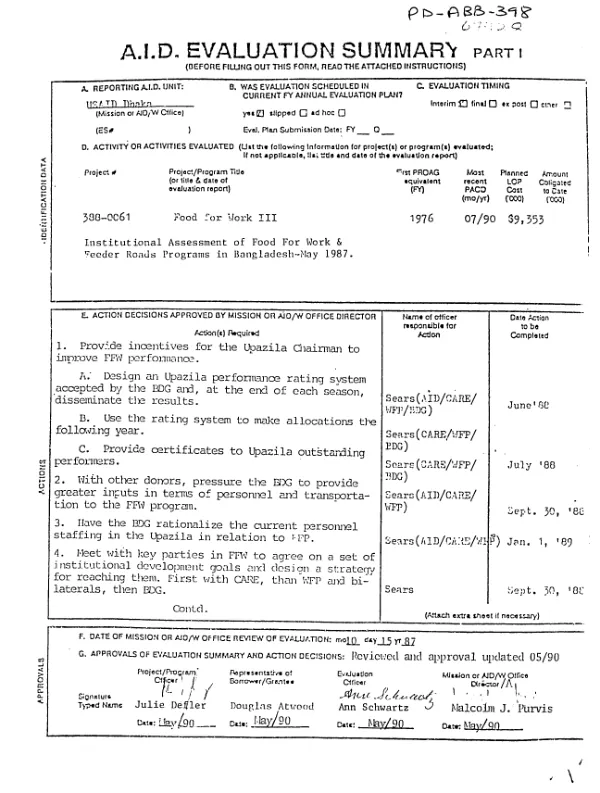
Summarizes the mid-term evaluation (PD-AAY-110) of the institutional aspects of CARE"s Food for Work (FFW) and Feeder Roads programs in Bangladesh.
1990
Sign in to readA free account is required to download.
Abstract
Results have been mixed, as performance by individual Upazilas (sub-districts) in implementing FFW has varied considerably. Upazilas with superior performance have committed Upazila Chairmen and sound management practices in which the Upazila Parishad functioned as a team. Poor performers generally have ambiguous personnel relationships and are understaffed. Performance has also been dependent on physical variables. Large Upazilas with many Unions and poor transportation tend to be poor performers due to the difficulties in reaching work sites by Upazila management personnel. Moreover, Upazilas with sandy soil and high distress factors have performed poorly. Institutional efficiency has suffered from a lack of a clearly defined strategy. Such a strategy would incorporate training, incentives for performance, publicity, and greater public participation. Finally, the decentralization of the Feeder Roads program was not advantageous when funding was above the minimal levels. See also abstract under PD-AAY-010. (Author abstract)
Connected topics
Related documents