BANK FOR WEST AFRICAN DEVELOPMENT
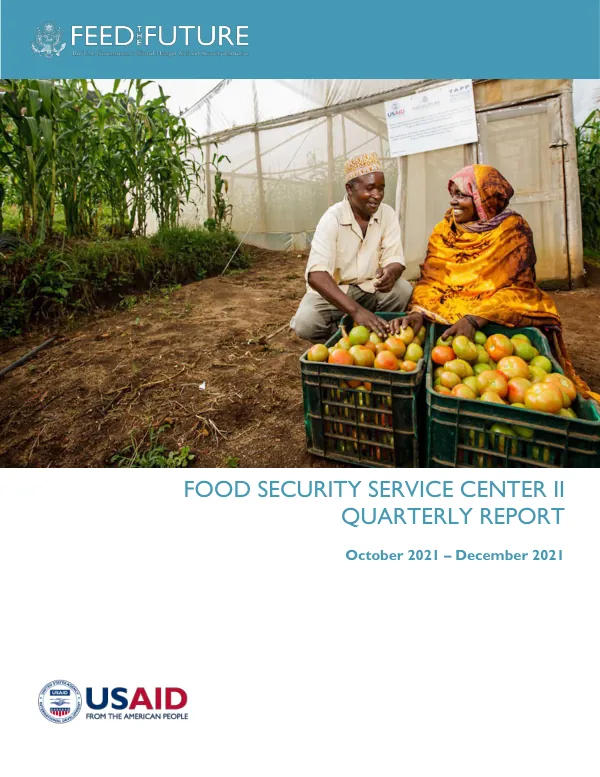
FOOD SECURITY SERVICE CENTER II QUARTERLY REPORT October 2021 – December 2021
The Food Security Service Center II (FSSC II) is a program launched in 2019 to provide technical assistance to the U.S.
2021 · 23 pages
Sign in to readA free account is required to download.
Abstract
Agency for International Development's (USAID) Bureau for Resilience and Food Security (RFS) in implementing the Global Food Security Strategy (GFSS). FSSC II is led by the International Development Group (IDG) and draws on the expertise of 11 federal agencies. The program's core objectives are to provide state-of-the-art expertise for program and project design, expert analyses and problem identification, and capacity building to incorporate the core objectives of GFSS into programming. FSSC II technical experts deliver a broad range of integrated, knowledge-driven technical services to support RFS' intermediate results. During the quarter from October 1, 2021, to December 31, 2021, the FSSC II team managed ongoing assignments while continuing to respond to new requests from RFS with high-quality professionals. Major highlights during the quarter include the addition of 35 new professionals with expertise in gender, knowledge management, and communication to the FSSC II database. The database now houses 523 professionals, 7% more than the last quarterly report, and continues to be the key recruiting tool for the team. The FSSC II team also achieved swift placement of consultants, with 93% of consultants placed on RFS assignments recruited from the database. However, due to a new USAID requirement to obtain facilities access clearance, consultants cannot start work until clearance is granted by the Security Office (SEC), which can take approximately 4-6 weeks. At the end of the quarter, FSSC II had 36 active assignments with 46 consultants working on assignments, including 27 consultants under contract working with USAID in Washington and 19 consultants supporting Missions. Due to the pandemic, most of these professionals are working remotely in the U.S., but travel to the Missions is resuming. FSSC II's Monitoring, Evaluation, and Learning (MEL) Plan outlined three indicators to be measured and reported on a quarterly basis. The first indicator is the percent of technical assistance requests received and responded to by FSSC II, which was 100% during the quarter. The second indicator is the percent of consultant contracts executed within 48 hours of the FSSC II receiving USAID COR approval, which was 82% during the quarter. The third indicator is the number of knowledge products disseminated through the USAID Development Clearinghouse (DEC) and in partnership with Agrilinks and other existing platforms, which was seven documents approved by the COR during the quarter. International travel has not resumed for most consultants due to the pandemic, but the FSSC II team continues to build a solid database of food security experts and provide high-quality technical assistance to RFS.