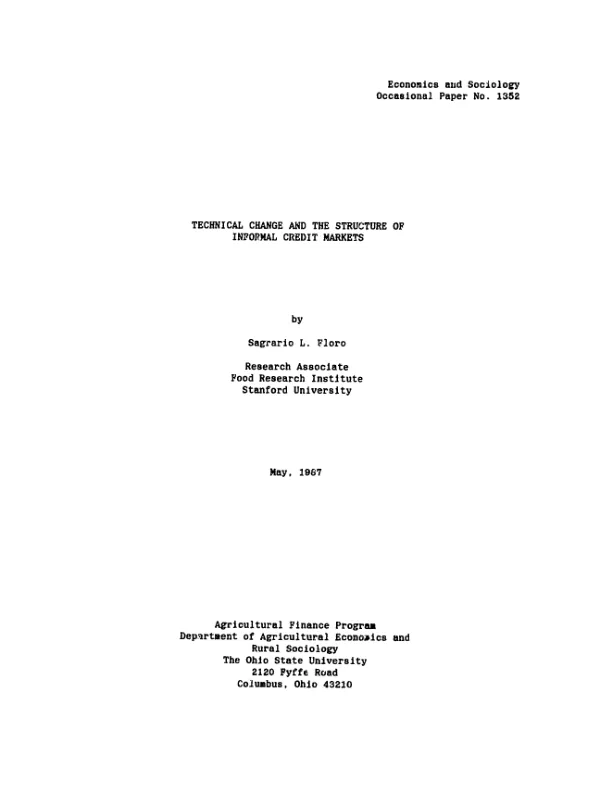
OHIO STATE UNIVERSITY. DEPT. OF AGRICULTURAL ECONOMICS AND RURAL SOCIOLOGY
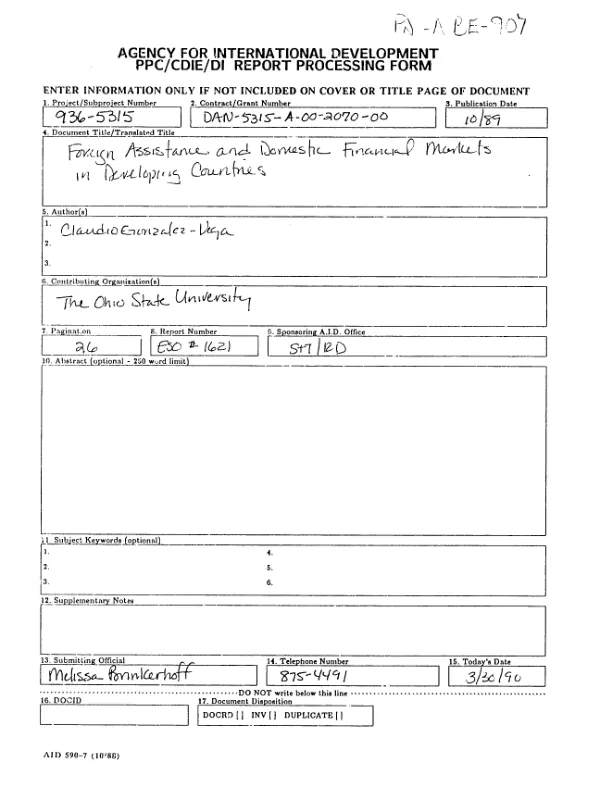
Foreign assistance and domestic financial markets in the developing countries
International donor response to the Central American economic crisis has largely been in the form of abundant financial assistance.
Gonzalez Vega, Claudio · 1989
Sign in to readA free account is required to download.
Abstract
The United States, for example, allocated $8.4 billion to the region for fiscal years 1984-1989. This paper raises questions regarding the effectiveness of such assistance, claiming that it may have actually neutralized the healthy impact of crises on the evolution of economic policies. That is, by bailing governments out, foreign aid has allowed the persistence of unsustainable consumption levels and distorting policies, thereby postponing and increasing the inevitable social costs of a weak economy. In extreme cases, assistance may have made it possible for the public sector to enter into productive activities in direct competition with existing or potential private investors. Financed with foreign savings, these state-owned enterprises may have crowded out private firms in credit portfolios and in access to specific resources. Characterized by high capital-output ratios, the public sector ventures have added little to social profitability. In conclusion, the paper states that foreign financial assistance can facilitate the economic recovery of Central America only if it does not substitute for necessary domestic reforms.
Connected topics