USAID. BUR. FOR POLICY AND PROGRAM COORDINATION. CENTER FOR DEVELOPMENT INFORMATION AND EVALUATION (CDIE)
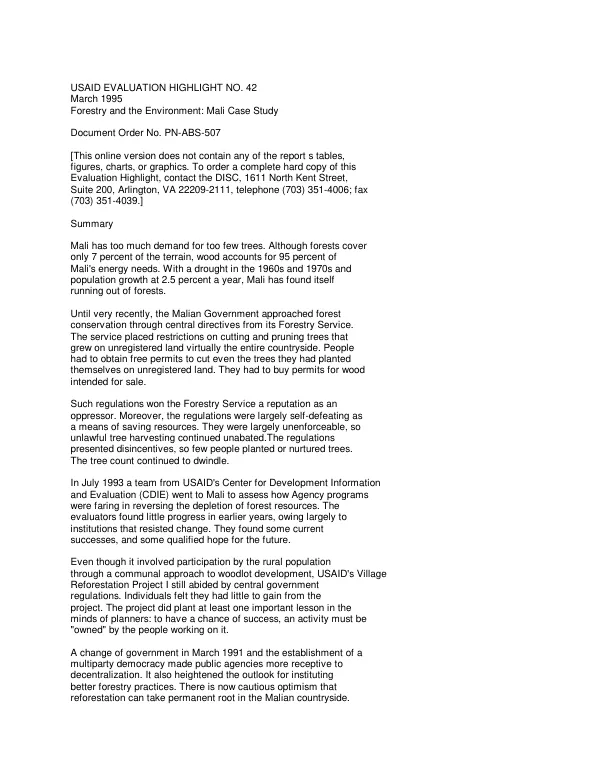
Forestry and the environment : Mali case study
Mali is running out of forests.
Fessenden, Abbe|Duval, LeRoy|Kanoute, Alassane · 1994
Sign in to readA free account is required to download.
Abstract
Although wood accounts for 95% percent of Mali's energy needs, forests cover only 7% percent of the country's terrain, a situation exacerbated by the droughts of the 1960s and 1970s and by an annual population growth rate of 2.5%. This report assesses the effect of USAID projects aimed at in reversing the depletion of forest resources in Mali. Major findings are as follows. (1) The protectionist, state-oriented approach of Mali's Forestry Service has been ineffective. (2) U.S. and local NGOs have played major roles in implementing group and individual forestry management programs. (3) The Village Reforestation Project succeeded in building local "ownership" of forest conservation measures in project villages. (4) Since the droughts of the 1960s and 1970s, Malians have a better working awareness of the role of forests and soil and water conservation. (5) Since 1991, Mali, with USAID assistance, has made rapid progress in policy reform. (6) Malian programs are using a wide variety of improved and borrowed technologies for group and individual forestry, natural resource management, and sustainable agriculture. (7) Inadequate information systems and linkages have limited the usefulness of USAID-funded forestry activities in identifying extendable technologies. In conclusion, USAID forestry programs in Mali are successful as pilot efforts that combine approaches to forestry and sustainable agriculture. Constraints to long-term sustainability of these programs include the lack of efficient linkages between research and extension and the fact that Forest Service carries out both extension and policing activities. Lessons learned are as follows. (1) A sense of ownership is critical in a group undertaking. (2) Effective forestry management requires broadening political participation through decentralization and delegation of rule-making authority. (3) Forestry interventions are more likely to succeed when implemented simultaneously with agricultural interventions. (4) A single agency cannot effectively carry out both enforcement and extension functions. An extensive bibliography is appended.
Related documents