GLOBAL COMMUNITIES
Formative Evaluation of USAID/Kosovo’s Up to Youth Activity
The Up to Youth activity in Kosovo aims to empower youth for positive change in their respective communities and build youth resilience to risky behaviors.
2021 · 51 pages
Sign in to readA free account is required to download.
Abstract
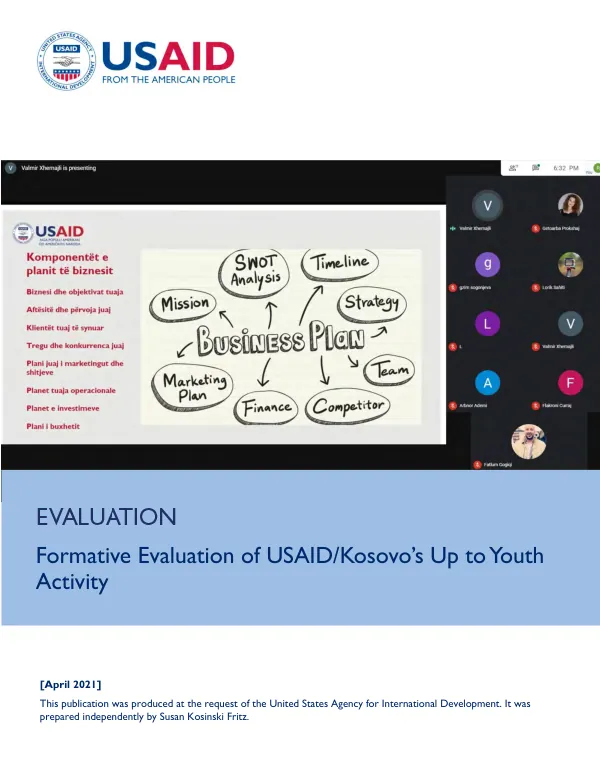
The five-year activity addresses youth ages 15-24 vulnerable to social exclusion by mobilizing and engaging youth in meaningful ways to effect positive change in nine municipalities in three geographic clusters in Kosovo. The project works with youth 15-24 years old, divided into two cohorts of 15–18-year-olds and 18–24-year-olds, targeting both in-school and out-of-school youth with age-appropriate activities. Up to Youth is implemented through three interconnected objectives: 1. Youth mobilized to be forces for positive change; 2. Youth life/soft skills developed and demonstrated; and 3. Environment for youth engagement fostered by stronger resilience partners. The project's Collaborating, Learning, and Adapting (CLA) activities are designed to facilitate learning and adaptation among project staff, youth, and other stakeholders. A formative performance evaluation of the Up to Youth activity was conducted to identify the most and least effective approaches to online project implementation platforms. The evaluation utilized mixed methods, including qualitative research methods (Semi-Structured Interviews, Focus Group Discussions, and Direct Observation) and quantitative methods (Close-Ended Survey). The evaluation used a Snapshot Design, evaluating the Up to Youth activity at a single point in time and answering descriptive questions. The evaluation found that overall, those involved in Up to Youth have a positive impression of the program. However, youth beneficiaries have been affected in their ability to participate in Up to Youth's online activities. The biggest challenges to participating in Up to Youth online activities are technical – internet connection and electricity. A challenge to both the online and in-person formats is a lack of time. The most effective approaches to online training include Nearpod and other ways to make the content engaging and interactive, including shortening it and providing a more flexible schedule. Serbian-speaking youth have greater challenges to participating. Up to Youth should continue to adapt to meet the needs of its beneficiaries to the maximum extent practicable, and pay particular attention to the needs of Serbian-speaking youth and Youth with Disabilities to ensure that the project's social inclusion goals are met. Recommendations include continuing to gauge youth beneficiaries to tailor the training format and schedules to meet their needs, ensuring that new youth joining the project have the technical capacity to participate, and considering providing trainings delivered in English. The evaluation also highlights the importance of addressing the needs of Youth with Disabilities and ensuring that the project's social inclusion goals are met. The evaluation was conducted remotely using Google Meet to interview respondents and to conduct Focus Group Discussions, which does not allow for observing and interpreting body language. The implementing partner was heavily involved in organizing and in most cases, participating in data collection, which may have affected how respondents answered. The evaluator had to rely on translators, which may have resulted in missing nuances in what was said. Youth may have responded differently if participating in Focus Group Discussions in front of parents.