USAID DEC
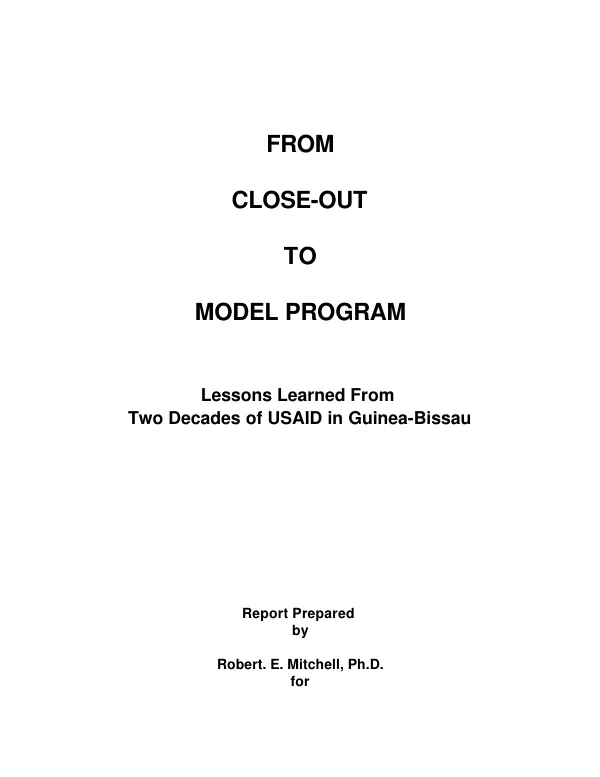
From close-out to model program : lessons learned from two decades of USAID in Guinea Bissau
Sign inUSAID. MISSION TO GUINEA-BISSAU
From close-out to model program : lessons learned from two decades of USAID in Guinea Bissau
In 1989, when USAID/W reversed its earlier decision to close the Mission in Guinea-Bissau, USAID/GB began evolving a new assistance strategy which provides a model for other small USAID Missions.
Mitchell, Robert E. · 1995
Sign in to readA free account is required to download.
Abstract
This strategy, which links improved governance and participation directly to private sector development and economic growth, was consolidated in the Trade and Investment Promotion Support (TIPS) project (1992), which is virtually coterminous with the Mission's program. Evidence to date suggests that the new approach is having a beneficial effect on increased private sector activities in critical growth sub-sectors. This report describes the major phases of this strategy development and the lessons learned from it. The unique design of TIPS arose from the nature of the governance constraints the project needed to address, which required that the contractor have a range of skills generally not available from a single firm. As a result, the contractor is a five-member consortium in which no single member has competencies across the full project design and its four technical components. Despite possible problems in this structure, TIPS has had remarkable success, critical to which was the contractor's ability to get off to a very rapid start because (a) the Mission had been implementing a coherent program since early 1991 and had procured equipment and space prior to the contractor's arrival; (b) the contractor was able to send its core team to Bissau twice before formal start-up; (c) the consortium provided excellent long-term and short-term experts; (d) USAID's public and private sector customers and partners accepted the premise of the TIPS project; and (e) the project design and the contract were model documents. Instead of organizations and institutions, TIPS emphasizes governance, procedures, policy reforms, the appropriate legal and institutional infrastructure, including democratic governance, fair and impartial adjudication of trade and investment (T+I) conflicts, civil society, and participation. It is the program outputs that TIPS makes sustainable and what Guinean public and private institutions are replicating. There are four series of lessons learned from this history of USAID/GB over two decades, especially since 1991. Structure of a Small Mission's Model Program. (1) Narrow the program focus to a single strategic objective. (2) Concentrate program funds in a single project so that the program and project are largely interchangeable. (3) It is possible (up to a point) to design and implement a program without bilateral funds. (4) Managing a program rather than a project requires that the entire assistance portfolio be deployed as components of a single, focused strategic objective. (5) Program sustainability refers to impacts and results, not projects, inputs, or institutions. (6) Operational constraints, though important, should not unilaterally and uncritically shape program decisions. (7) Effective policy dialogue need not focus solely on particular policy issues. USAID/GB had considerable success in explaining and promoting frameworks for identifying policy issues and the means to address them. Handling Controversial Projects and Programs. (1) A new Mission with responsibility for shaping a controversial Project Identification Document (PID) into an acceptable Project Paper (PP) should seek USAID/W's early reactions to fresh ideas and variations in the PID. In trying to save time by moving directly to the PP, the Mission ultimately lost time. (2) A Mission that is in the vanguard of Agency thinking should shape the debate with Washington by identifying weaknesses in the prevailing wisdom and how the proposed alternative compensates for them. Lessons on Procurement. A. Performance-Based Contracts. (1) Such contracts, which focus exclusively on performance at the strategic objective level, are inappropriate for complex programs that incorporate program outcomes and project sub-outcomes as necessary and sufficient for achieving strategic objective impacts and for which processes (especially governance-related processes) are critical. (2) Graphic displays of contractor responsibilities helps the contractor to focus on them. B. Master Contracts. (1) A project design which includes separate but related technical components enables the contractor to adjust to changing local conditions by shifting resources among the components. (2) Master contracts may not be the most suitable implementation mechanism for a project with several technically specialized components, especially if the prime contractor has little experience in major portions of the contract. (3) Master contracts should include specific wording on the project coordinator's function vis-a-vis the different members of a consortium of contractors. (4) A Mission needs to understand what and why contractor interests differ from those of the Mission. (5) Require the contractor to report on goal-level indicators, as well as on the project purpose and outputs. When combined with specific indicators of contractor success/failure, this requirement will keep the contractor constantly aware of what the project is about; it also contributes to a critical re-examination of project design and contractor performance. Both USAID/GB and the contractor become learning organizations. This is especially important for governance programs. Designing for Governance. (1) Governance can be a successful approach to increasing private sector economic activities. It should not, however, be operationalized, as in the objectives and outputs of the four technical components in the TIPS contract and the four program outcomes in the Mission's program. These objectives and outputs identify the results of removing governance constraints to private sector activities in specific economic subsectors. (2) Projects to assist a country's reform program will differ according to (a) who (international financial institutions or the host government) defines the program agenda and (b) how broad-based the agenda is. The Government of Guinea-Bissau took on both economic and political reforms but had few structures and procedures for managing the reform process. A strategy focused solely on individual reforms (e.g., rice policy) may have little effect without attention to systemic problems. (3) Many obstacles to policy reform are more political than technical, requiring USAID expertise in political and governance analysis. (4) Successful governance reform efforts need not involve ministers on a continuing basis. There is proven merit in involving the "best, brightest, and boldest" in problem-identification, research, development, and implementation tasks that give the counterparts ownership of the initiatives.