RTI INTERNATIONAL
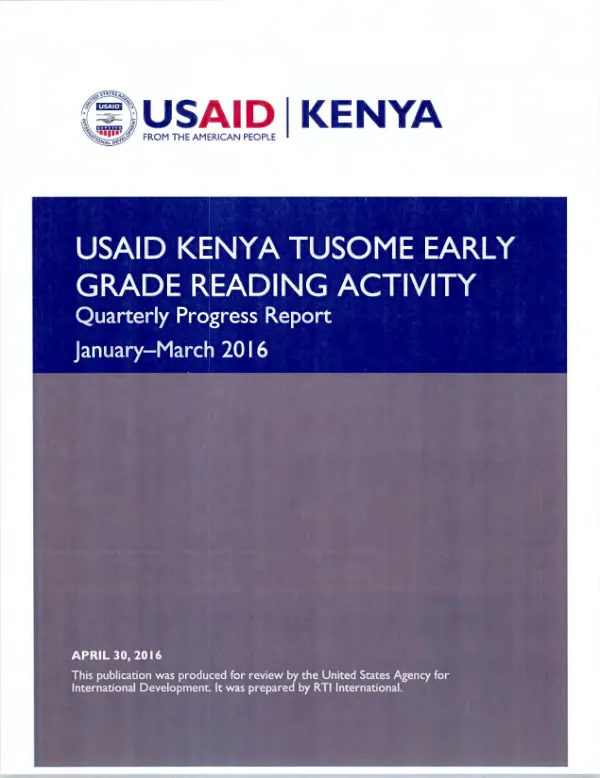
FY 2016 QUARTER 2 PROGRESS REPORT USAID KENYA TUSOME EARLY GRADE READING ACTIVITY
The USAID Kenya Tusome Early Grade Reading Activity is a program aimed at improving reading skills among primary school students in Kenya.
2016 · 91 pages
Sign in to readA free account is required to download.
Abstract
The program began in 2015 and is funded by the United States Agency for International Development (USAID). The program's primary goal is to increase the number of students who can read at grade level by the end of Grade 2. To achieve this goal, the program focuses on three key areas: increasing the availability and use of appropriate textbooks and supplementary materials, improving methods of reading instruction delivery, and providing supervision support to teachers. The program also aims to create an improved policy environment that promotes reading skills. In the first quarter of 2016, the program made significant progress in increasing the availability and use of textbooks and supplementary materials. The program procured and distributed Class 2 learning materials to all public schools, distributed teaching and learning materials to APBET institutions, and procured supplementary readers from the Kenya Publishers Association. The program also implemented the World Reader e-reader and reviewed information and communication technology tools. In terms of improving methods of reading instruction delivery, the program updated and reviewed plans to develop training, reviewed and revised training materials, and trained national trainers, CSOs, and instructional coaches. The program also provided supervision support to teachers by CSOs, instructional coaches, and head teachers, and supported the implementation of youth fund grants. The program also made progress in creating an improved policy environment that promotes reading skills. The program provided professional and institutional capacity building for the Ministry of Education, Science and Technology (MoEST) and the Teachers Service Commission (TSC), and trained ESQAC officers and QASOs. Despite the progress made, the program faced several challenges, including constraints and opportunities for the public school system. The program encountered issues with the suitability tests and transfer of CSOs, appointment of new CSOs, maintenance of teaching and learning materials, transfer of Tusome-trained teachers, and up-to-date public school enrollment data. The program also faced challenges in APBET institutions, including lack of commitment by some institutions, closure of some institutions, and limited support from some head teachers and directors. The program is working to address these challenges and ensure the sustainability of the program. The program's performance monitoring and evaluation framework is designed to track progress towards the program's goals and objectives. The framework includes indicators such as the number of students who can read at grade level, the number of teachers trained, and the number of textbooks and supplementary materials distributed. The program's gender and inclusion strategy aims to ensure that the program's benefits are equitably distributed among all stakeholders, including girls and boys, and students with disabilities. The program is working to ensure that all stakeholders have equal access to the program's resources and opportunities. The program's links to other USAID programs and government agencies are critical to its success. The program is working to leverage resources and expertise from other programs and agencies to support its goals and objectives. The program's sustainability and exit strategy is designed to ensure that the program's benefits are sustained beyond the program's lifespan. The program is working to build the capacity of local stakeholders, including teachers, head teachers, and CSOs, to continue the program's work after the program's exit. The program's financial information is managed in accordance with USAID's financial management policies and procedures. The program's budget is allocated to support the program's activities and objectives, and the program's financial reports are submitted to USAID on a regular basis.