USAID DEC
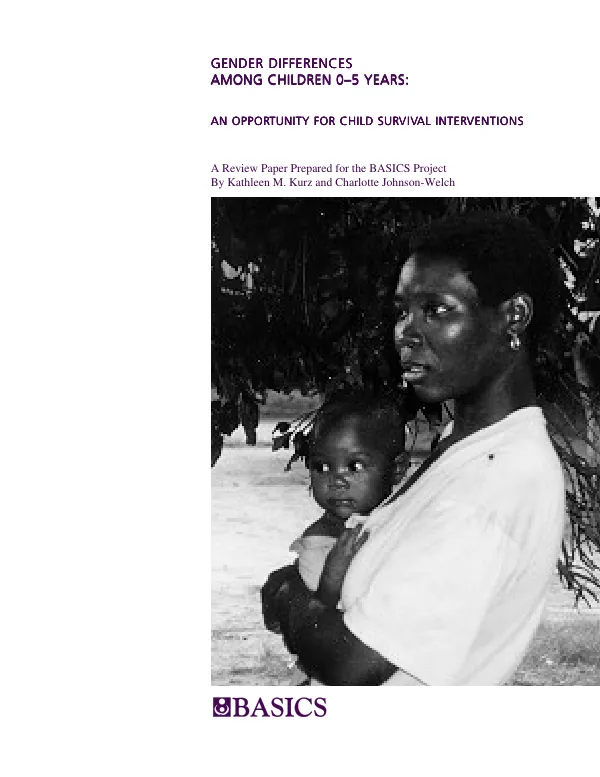
Gender bias in health care among children 0-5 years : opportunities for child survival programs
Sign inPARTNERSHIP FOR CHILD HEALTH CARE, INC.
Gender bias in health care among children 0-5 years : opportunities for child survival programs
A literature review was conducted to determine whether gender bias may help explain evidence that in many developing countries girls under age five have higher mortality rates and poorer health and nutritional status than boys.
Kurz, Kathleen M.; Johnson-Welch, Charlotte · 1970
Sign in to readA free account is required to download.
Abstract
The study addressed five questions. (1) To what extent are gender-disaggregated data available on the health and nutrition of under-fives? (2) What is the extent of gender disparity in health and nutritional status among under-fives? (3) What factors influence gender disparities in under-five health and nutritional status? (4) What has been learned from intervention studies about reducing gender differences? (5) Are these gender disparities more prevalent in some regions than others? Information was sought on mortality and morbidity patterns, health care practices, nutritional status, feeding practices, and psychosocial development. Specific observations include the following. (1) Few studies disaggregated health and nutrition data by gender. (2) Gender-disaggregated data were mixed, but generally demonstrated bias against girls. (3) Few insights explaining gender differences emerged from a review of the literature. (4) A common way in which gender bias manifests itself is that girls tend not to be taken for health care as often or as early in their illness as boys. (5) Girls may receive less or poorer quality food than their brothers. (6) Girls may receive less attention from parents. (7) First-born girls may be healthier than their younger sisters. (8) Increasing household income and increasing mothers" education are not sufficient to reduce gender disparities. (9) Interventions can be designed and implemented to overcome gender biases. Overall, the review indicated that gender differences in the health and nutrition of under-fives exist in every region and were reflected more often in smaller studies than in national-level statistics. Bias against girls was shown consistently in three areas: health care utilization, feeding patterns, and attention from care providers. Recommendations for reducing gender differences in the health and nutrition of under-fives are offered in conclusion. (Author abstract, modified)
Related documents
Documents in this collection
 1998
1998USAID DEC
Quantifying the benefits of breastfeeding : an annotated bibliography
Open record 1997
1997USAID DEC
![Adaptation of infant and young child feeding recommendations for IMCI [integrated management of childhood illness] : Kazakhstan, and overview of adaptation process](https://covers.devme.ai/gen/45086.webp)