USAID DEC
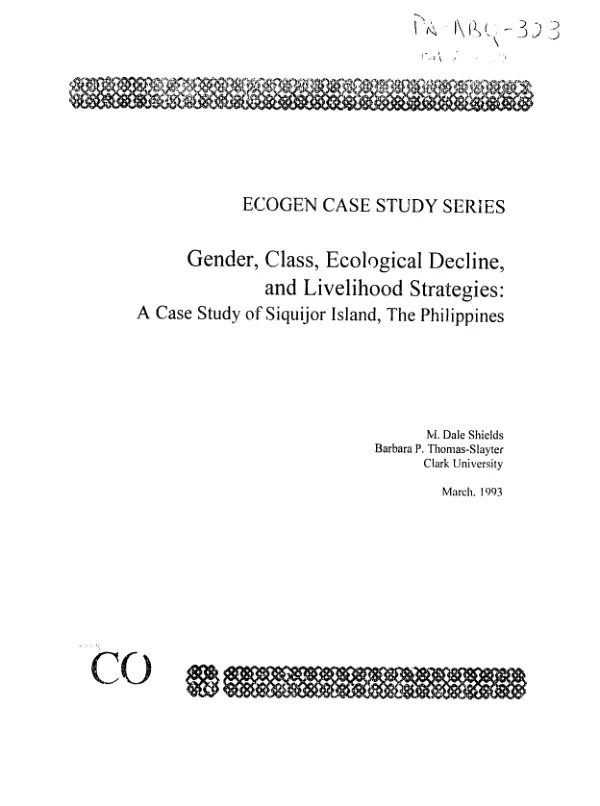
Gender, class, ecological decline, and livelihood strategies : a case study of Siquijor Island, The Philippines
Sign inCLARK UNIVERSITY. INTERNATIONAL DEVELOPMENT PROGRAM
Gender, class, ecological decline, and livelihood strategies : a case study of Siquijor Island, The Philippines
This case study examines the complex relationship between economic activity, gender roles, and environmental degradation in the villages of Tubed and Napo on Siquijor Island, a remote island province in the Philippines.
Shields, M. Dale; Thomas-Slayter, Barbara P. · 1993
Sign in to readA free account is required to download.
Abstract
Specific issues discussed include: (1) resource decline and issues of sustainability in the two communities; (2) household livelihood systems and stratification; (3) gender and class patterns of resource management; (4) community responses to challenging resource conditions; (5) links between household and community in assuring livelihoods; and (6) policy and research implications. Findings point to a critical linkage between gender and class formation and suggest that gender and class must be joined conceptually in analyzing rural communities in the Philippines. The study revealed: (1) a negative impact on gender roles and relations within poorer households, as their members enter the modern cash economy; (2) a reliance on social exchange networks which may be detrimental to the long-term preservation of the natural resource base; (3) the resilience and usefulness of indigenous groups, which are normally structured around gender and class interests; and (4) the integral role of migration for both men and women in the livelihood systems of the rural communities. Appendices contain a discussion of methods for gender-focused research in the Philippines and a sample of the survey used in this study.
Related documents
Documents in this collection
 1994
1994USAID DEC
Shifting boundaries : gender, migration and community resources in the foothills of Choluteca, Honduras
Open record 1995
1995USAID DEC