CARANA CORPORATION, INC.
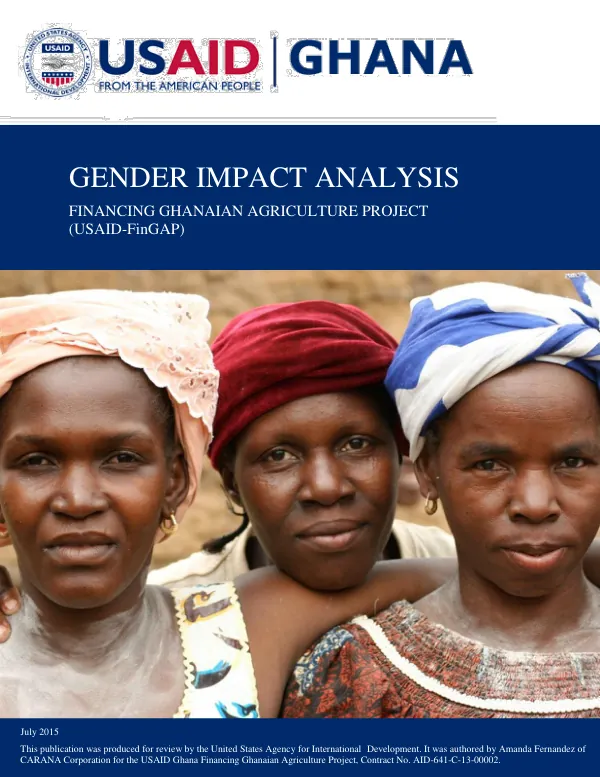
Gender Impact Analysis of the USAID-FinGAP Project
The Financing Ghanaian Agriculture Project (USAID-FinGAP) conducted a gender impact analysis between April 29 and May 6, 2015.
2015 · 33 pages
Sign in to readA free account is required to download.
Abstract
The analysis aimed to assess the project's performance in implementing gender activities outlined in the Year 2 work plan and to develop recommendations to strengthen USAID-FinGAP's ability to expand access to credit among female small, medium, and large enterprises (SMiLEs). The analysis found that USAID-FinGAP-supported SMiLEs, business advisory services (BAS) providers, and participating financial institutions (PFIs) are positively impacting access to finance, employment, and sales among women in each of the Feed the Future (FTF) target value chains of maize, rice, and soy. However, the project's performance indicators do not yet formally capture the extent of this impact. The USAID-FinGAP team has implemented the gender activities in its Year 2 work plan, and project leadership on the issue of gender has ensured that an appropriate focus has been applied by the project team. However, a detailed analysis of agricultural credit demand in these value chains that disaggregates demand by gender has not been conducted, and could be a useful tool to guide future financing and investment decisions. Women can be found in virtually every segment of the targeted value chains, but they are concentrated upstream and face the highest risks, the highest interest rates, and the smallest amount of credit demanded along the chain. Financing demand among women in all segments of each value chain remains grossly unsatisfied, and micro actors in the target value chains are most constrained in terms of accessing formal finance. The analysis also found that there are few female-led BAS firms operating in Ghana, and holding investment "mini-summits" in the target geographic regions has proven effective in reaching more women with access to finance. Female SMiLEs in the target value chains require different types of technical assistance than their male peers, and bundling women into groups has also functioned well to extend credit to upstream actors. On the supply side, a number of Ghana's PFIs are expanding their service offerings to female customers, including new products, networking tools, and inclusive finance strategies. Project-supported PFIs are quickly expanding their market share in the agribusiness lending space and in the target value chains, although mostly without having conducted detailed analysis of the financing demand within the target value chains, or without considering the different financial needs of men and women agribusiness actors within these value chains. Given high interest rates facing the agribusiness sector, PFIs are seeking alternative sources of capital, and in particular concessional capital, to expand service provision to agribusiness, and to women. A large data gap exists for quantifying the level of access to finance among women, as few PFIs strategically track agribusiness lending performance disaggregated by gender. Recommendations to continuously expand financial services access among women in the target value chains include refining data tracked by the project to expand information on associated on-lending disaggregated by gender, systematically tracking each transaction/deal's connections with other FTF projects, and beginning systematic collection of agricultural firm-level data to improve understanding of performance. Additionally, holding more mini-summits in the target geographic areas, supporting development of female networks, and highlighting female SMiLE successes in communications efforts are recommended to continue to expand access to finance among women.