USAID. MISSION TO LESOTHO
General manpower development and training
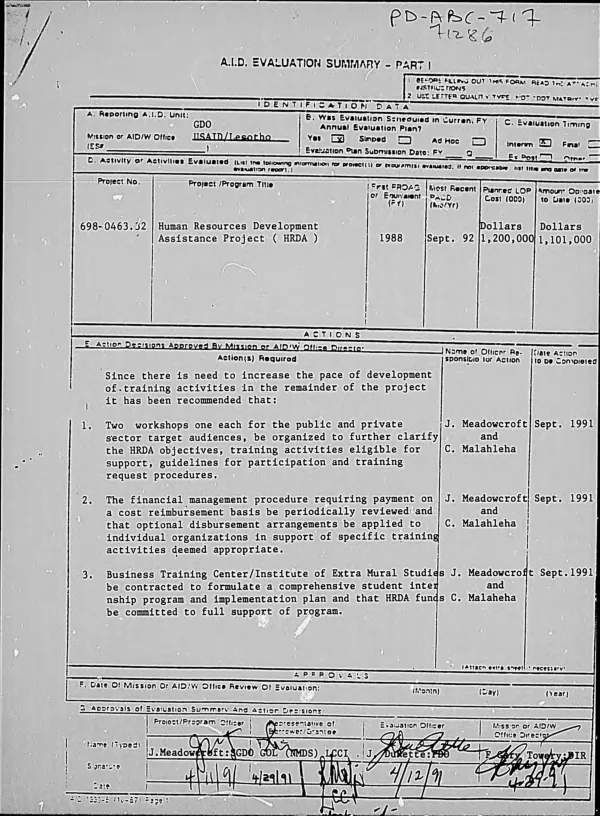
PES summarizes external evaluation (available as part of this document or as PD-AAT-850) of a project to upgrade the institutional capacity of the Government of Lesotho (GOL) through participant training in African institutions and the placement of U.S.
Layne, Patsy P.; Bereng, N. +1 more · 1986
Sign in to readA free account is required to download.
Abstract
operational experts (OPEX) in positions not filled by GOL personnel. The evaluation covered the period 1981-8/84 and was based on document review and interviews with project personnel and beneficiaries. The project met most of its quantitative targets: 944 person-months (PM"s) of long-term OPEX support and 1,284 PM"s of long-term, external training were provided, against identical targets of 1,080 PM"s. Altogether, 28 OPEX staff have worked in 25 positions within GOL departments (some did work over and above their specific duties), and 73 persons have been sent for training, of whom 47 have completed training as planned, 3 received lesser degrees/diplomas than planned, and 3 did not finish; 20 participants remain in training. One problem was that trainees remained in school longer than planned. Also, the project fell short of its goals of 65 PM"s of short-term TA and 24 PM"s of short-term participant training. It is questionable, however, if these achievements will result in the desired institutional improvements in the GOL. Thus far, only about half of the returned trainees have assumed positions filled by OPEX staff; in the other cases, there was not a precise match between the OPEX position and the training offered. Also, in some cases OPEX staff operated at such a high level of expertise that counterparts found it difficult to replace them. Nonetheless, 47 of the 51 returned trainees are working in the position for which they were trained; those with advanced degrees are working mainly in institution strengthening and organization development, those with first degrees as lecturer/trainers or engineer/technicians. Several lessons were learned. (1) Training takes longer than planned, resulting in either discontinuities between the departure of OPEX staff and assumption of duties by trainees or extensions of OPEX contracts. (2) Replacement of OPEX staff by returned trainees is not a one-to-one exchange as the experience and ability of the two groups will differ; thus, neither the GOL nor USAID/L should expect direct improvements in efficiency or maintenance and reinforcement of changes introduced by OPEX staff. (3) Aid of this type pleases participants and public agencies; more of this aid is recommended, with a possible shift toward training high-level civil servants for shorter periods, to minimize discontinuities. (4) The major external factor affecting the project was the multiplicity of donor programs in Lesotho, and their often contradictory nature.
Related documents