USAID DEC
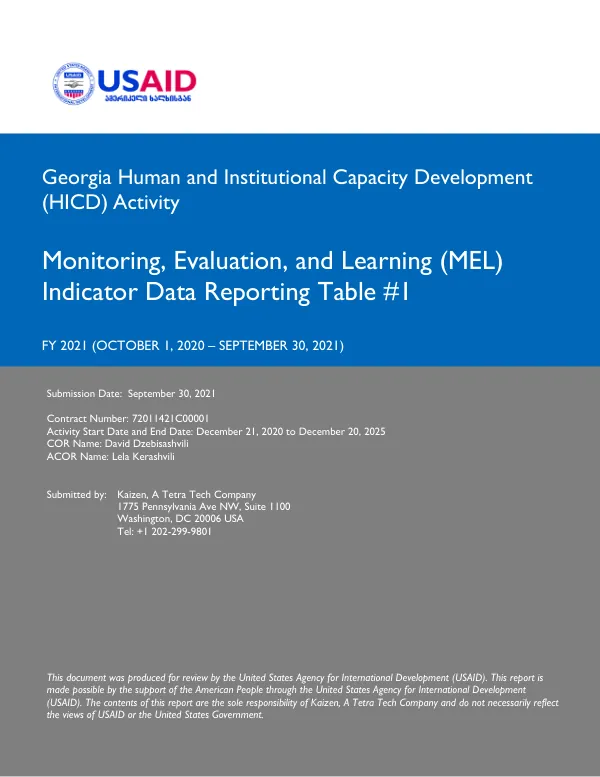
Georgia Human and Institutional Capacity Development (HICD) Activity Monitoring, Evaluation, and Learning (MEL) Indicator Data Reporting Table #1
Sign inUSAID DEC
Georgia Human and Institutional Capacity Development (HICD) Activity Monitoring, Evaluation, and Learning (MEL) Indicator Data Reporting Table #1
Georgia Human and Institutional Capacity Development (HICD) Activity is a program aimed at strengthening the capacity of Georgian institutions.
2021 · 4 pages
Sign in to readA free account is required to download.
Abstract
The program is funded by the United States Agency for International Development (USAID) and is implemented by Kaizen, A Tetra Tech Company. The program's goal is to enhance the capacity of Georgian institutions to effectively manage and implement development projects. The program's monitoring and evaluation (MEL) indicator data reporting table provides information on the program's progress and achievements. According to the table, the program has made significant progress in strengthening the capacity of Georgian institutions. In the first year of the program (2020-2021), 14 governmental organizations and NGOs received support for institutional capacity development (HICD) services, including six NGOs, the Public Defender's Office, Sakpatenti, GAPOR, GNCA, MAG, NASP, MoESD, and Fund "Sukhumi". One governmental organization, the Central Securities Depository (CSB), received long-term HICD services. The program's performance indicators (PIRs) are designed to measure the program's progress and achievements. PIR 1 focuses on strengthening the capacity of partner institutions, while PIR 2 aims to establish and operationalize the Centre of Excellence (CoE) as an effective, innovative, and sustainable hub for knowledge management. PIR 3 focuses on developing systems, policies, and procedures that enable subcontractors to compete for and manage large donor awards. PIR 4 aims to ensure that USAID-sponsored exchange visitors successfully avail of the contractor's participant training (J-1 Visa) processing services. The program's MEL indicator data reporting table provides information on the program's progress and achievements in each of these areas. For example, in the first year of the program, 12 Georgian institutions received USG assistance, and 14 governmental organizations and NGOs received HICD services. The program also established the Centre of Excellence, which counts 72 newly registered members as of September 30, 2021. The program's subcontractors have also made progress in developing systems, policies, and procedures that enable them to compete for and manage large donor awards. The program's performance indicators are designed to measure the program's progress and achievements over time. For example, PIR 1 aims to strengthen the capacity of partner institutions, with a target of 40 institutions receiving USG assistance by the end of the program. PIR 2 aims to establish and operationalize the Centre of Excellence, with a target of 75% of local ownership by the end of the program. PIR 3 aims to develop systems, policies, and procedures that enable subcontractors to compete for and manage large donor awards, with a target of 5 subcontractors leading large donor awards by the end of the program. PIR 4 aims to ensure that USAID-sponsored exchange visitors successfully avail of the contractor's participant training (J-1 Visa) processing services, with a target of 90% of exchange visitors expressing satisfaction with EVs processing services by the end of the program. The program's MEL indicator data reporting table provides a comprehensive overview of the program's progress and achievements. The table provides information on the program's performance indicators, including the number of Georgian institutions receiving USG assistance, the number of HICD services provided, and the number of Centre of Excellence members. The table also provides information on the program's subcontractors, including the number of subcontractors leading large donor awards and the average performance evaluation score.
![Promoting Integration, Tolerance and Awareness Program in Georgia [PITA] Final Program Report](https://covers.devme.ai/gen/140357.webp)