CHEMONICS
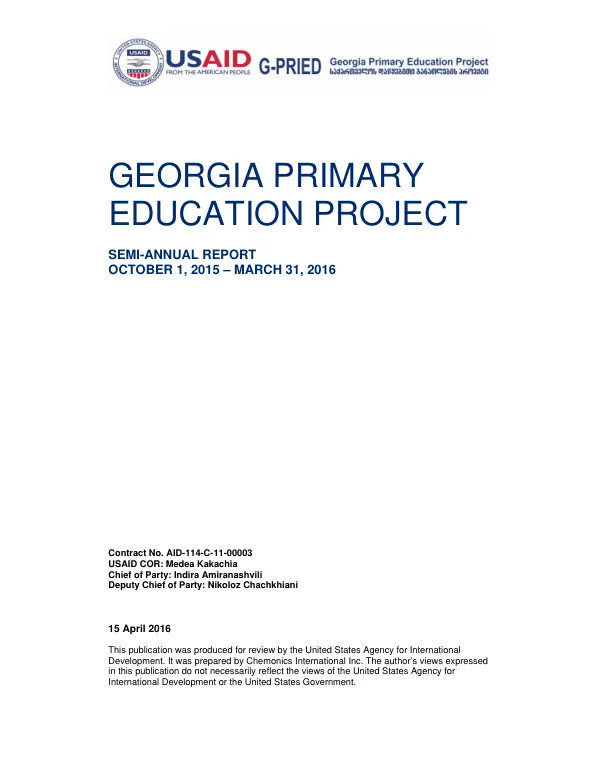
Georgia Primary Education Project Semi-Annual Report: October 2015 - March 2016
The Georgia Primary Education Project (G-PriEd) aims to improve reading and math competencies of Georgian and ethnic minority students in grades 1-6.
2016 · 72 pages
Sign in to readA free account is required to download.
Abstract
The project is a five-year initiative that began in 2011 and is funded by the United States Agency for International Development (USAID). G-PriEd works closely with the Ministry of Education and Science to support instructional improvements, improve standards, and increase the use of instructional materials and formative assessments. G-PriEd's proposed model of teacher accreditation for academic year 2015-2016 was approved by the Teacher Professional Development Center (TPDC) and the Ministry of Education and Science (MES). The project designed, tested, and successfully launched a web-based portal at www.kargiskola.ge, which serves as a hub of G-PriEd instructional resources for use in the classroom. These resources include books, posters, games, and diagnostic testing materials, as well as electronic training courses and methodological materials for teacher professional development. The project also focused on improving reading and math instruction for approximately 40,000 students in approximately 300 schools. G-PriEd worked to enhance community and public engagement, accountability, and transparency in these schools. Additionally, the project aimed to improve business skills in at least 8,000 students in grades 1-6 in 35 schools. G-PriEd's implementation of the project's components has shown significant progress. The project's professional development activities for school educators have been successful, with the proposed model of teacher accreditation being approved by TPDC and MES. The web-based portal has been launched and is providing instructional resources to teachers. The project's focus on improving reading and math instruction has also shown positive results. G-PriEd has been working to improve the delivery systems for reading and math in Georgia's primary education system. This includes promoting professional standards and supporting professional development for teachers and administrators. In terms of community and public engagement, G-PriEd has been working to increase parental and community engagement in schools. The project has also introduced financial literacy skills in primary grades. The implementation of these components has shown significant progress, with the project's activities being conducted as it has emerged from the pilot phase to expand implementation to 465 additional schools. The project's timeline of events for the period of October 2015 to March 2016 includes a range of activities, including the launch of the web-based portal, the implementation of professional development activities for school educators, and the expansion of the project's implementation to 465 additional schools. The project's activities for the next semi-annual period (April-September 2016) include continuing the implementation of the project's components, including the expansion of the project's implementation to 465 additional schools. G-PriEd's collaboration with the Ministry of Education and Science and other stakeholders has been crucial to the project's success. The project's activities have been guided by the USAID policy on submissions of datasets to the Development Data Library and the language guiding the documentation of private sector leverage. The project's branding and marking plan has also been revised to reflect the changes in the project's scope of work. Overall, G-PriEd's implementation of the project's components has shown significant progress, with the project's activities being conducted as it has emerged from the pilot phase to expand implementation to 465 additional schools. The project's focus on improving reading and math instruction, enhancing community and public engagement, and improving business skills has been successful, with the project's activities showing positive results.