CULTIVATING NEW FRONTIERS IN AGRICULTURE
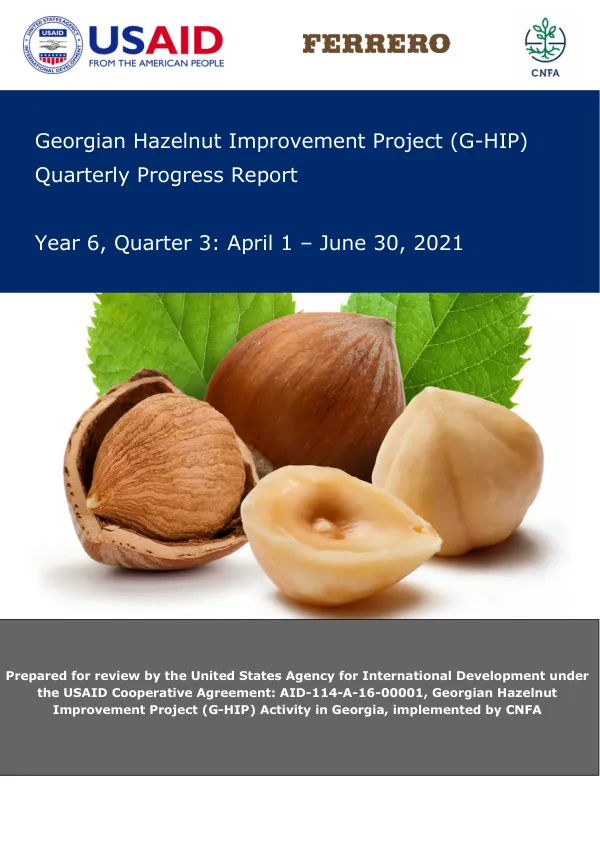
Georgian Hazelnut Improvement Project (G-HIP) Quarterly Progress Report
The Georgian Hazelnut Improvement Project (G-HIP) continues implementation of activities to increase the quality and quantity of Georgian hazelnut production, improve the processing capabilities of stakeholders in the hazelnut value chain, and establish market linkages that will allow smallholder growers to reach lucrative end markets.
2021 · 12 pages
Sign in to readA free account is required to download.
Abstract
As part of a long-term sustainability strategy, G-HIP focuses on enhancing the institutional capacity of the Georgian Hazelnut Growers Association (GHGA) through the provision of management, finance, and human resources training to association staff. G-HIP places a high priority in assisting GHGA to improve its governance, build its financial competency, optimize and maintain its operations, establish a performance management system, improve branding and outreach, grow its membership, and introduce new services for the sector. By the end of the reporting period, all restrictions imposed due to the COVID-19 pandemic were lifted, after more than a year of restricted travel, curfews, limitations on in-person meetings, and the like, which created a more challenging operating environment. G-HIP and its Alliance partners have achieved several key milestones and accomplishments through efforts to confront and address the structure and process-oriented challenges existing in the hazelnut sector. Key accomplishments during this reporting period include G-HIP support to GHGA for the Lead Farmer Training Program and other ongoing association activities, progress towards the establishment of a hazelnut traceability system in Georgia, the selection of international consultants for the introduction of alternate ways to finance sectoral associations, and the audit of GHGA and its subsidiaries, which will help G-HIP's efforts to develop the financial capacity of GHGA by identifying strengths and gaps. Throughout the quarter, G-HIP worked closely with the Ministry of Environmental Protection and Agriculture (MEPA), the National Food Agency (NFA), and the Rural Development Agency (RDA) to strengthen the hazelnut value chain through GHGA and the Hazelnut Exporters and Processors Association (HEPA) and to explore the possibilities for the establishment of new Husking, Drying, and Storage (HDS) facilities in Guria region with RDA assistance. A summary of G-HIP's key accomplishments during the third quarter is included in the following table: G-HIP completed an audit of GHGA and its subsidiaries, supporting GHGA's financial capacity development. The audit was conducted by the Audit and Consulting Group, and three separate audit reports were presented to G-HIP. The reports determined that all of the financial records given by the company do not contain any misrepresentations and all of the financial records of the company are well-maintained in accordance with the GAAP standards. G-HIP provided strategic support to GHGA to implement the student-training program. G-HIP supports training programs for students from the Agrarian University in Tbilisi, Akaki Tsereteli State University in Kutaisi, Shota Meskhia State Teaching University of Zugdidi, and Batumi Shota Rustaveli State University. To provide practical educational opportunities for University and Masters' students and promote the development of Georgia's hazelnut sub-sector, AgriGeorgia/Ferrero, G-HIP, and GHGA continue to support training programs for students. G-HIP supports efforts to establish a hazelnut traceability system in Georgia. The project is working closely with the Ministry of Environmental Protection and Agriculture (MEPA), the National Food Agency (NFA), and the Rural Development Agency (RDA) to strengthen the hazelnut value chain through GHGA and the Hazelnut Exporters and Processors Association (HEPA). G-HIP also supports the establishment of new Husking, Drying, and Storage (HDS) facilities in Guria region with RDA assistance. G-HIP awarded a subagreement to GHGA for Lead Farmers Trainings and support to ongoing activities of GHGA. G-HIP also supports efforts to find alternate ways of financing for the sectoral associations. The project is working closely with the Ministry of Environmental Protection and Agriculture (MEPA), the National Food Agency (NFA), and the Rural Development Agency (RDA) to strengthen the hazelnut value chain through GHGA and the Hazelnut Exporters and Processors Association (HEPA).