AMA TECHNOLOGIES, INC.
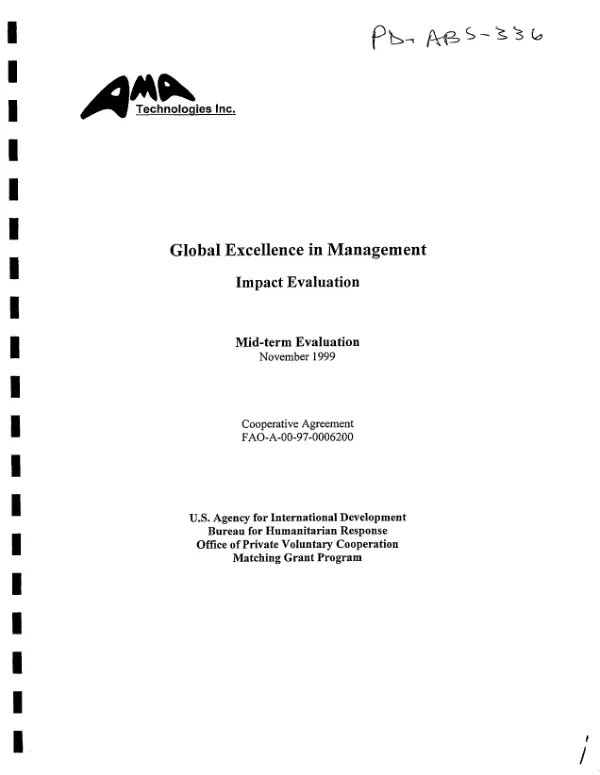
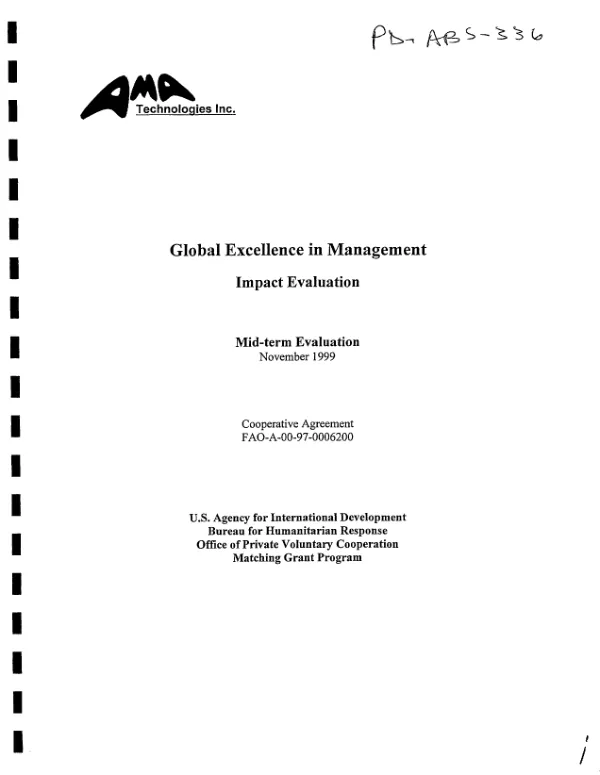
Global excellence in management : impact evaluation -- mid-term evaluation
Evaluates the Global Excellence in Management (GEM) Initiative, designed to build the organizational capacities of PVOs and NGOs to deliver effective development programs.
Norem, Rosalie Huisinga|VanSant, Jerry · 1999
Sign in to readA free account is required to download.
Abstract
Interim evaluation covers the period 1997-11/99. GEM is implemented by Case Western Reserve University (CWRU). GEM's activities occur on four levels -- the individual, the organizational, the inter-organizational, and the system-wide -- united by a common emphasis on improving organizational performance. The centerpiece of the GEM approach is called Appreciative Inquiry (AI), a capacity-building process that focuses on existing strengths rather than on problems. GEM's emphases parallel key elements in current management thinking about attributes of leadership and effective organizations. The reaction to AI as a workshop or retreat approach is overwhelmingly positive. AI, as used by GEM, also works especially well in multi-cultural contexts and with a wide variety of organizational agendas. PVOs/NGOs also view AI as a tool for their own use, but only in conjunction with other approaches more rooted in operational systems and procedures, and they believe it is unrealistic to avoid addressing real problems. On the negative side, concerns have been expressed, particularly by those who experience GEM on a one-time basis, about the applicability of GEM concepts in an actual organizational setting. Many cite a need for more follow-up, more support for post-event networking, and a more interactive website that would allow for "help desk" type services. There also is support for more focused training of selected staff of organizations who will be involved in follow-up implementation of GEM-based initiatives. GEM is, in fact, moving in these directions in response to its own feedback systems. Many also feel that GEM training itself needs to address management skills, at least those related to the application of GEM approaches. Some see avoidance of "problemsolving" as a lack of attention to the systems and procedures that are the lifeblood of organizations. The most consistently reported GEM impact was GEM's effectiveness in helping organizations take a forward-looking approach to planning. The methods and techniques are viewed as particularly enabling in making transitions within an organization around leadership change, decisionmaking processes, teamwork, and interpersonal issues. A second overall impact was the clear impetus that GEM program participants felt to actually transfer and adapt the methods and techniques to their own work situation. Lessons learned include the following: (1) GEM's approach and methods are most useful in visioning, goal setting, and strategic planning and less helpful in implementing organizational change. (2) Due to its focus on inward values and its reluctance to address "problems", GEM's approach does not adequately address exogenous structural elements. (3) Continuity of consultation relationships is effective in supporting organizational change. (4) Focused, sustained support for partnership development has paid off. In the most mature customized partnerships, there is good reason to believe that GEM initiatives will have a significant multiplier effect and broad impact at the grassroots level. Moreover, there is a good chance these positive outcomes will be sustainable. (5) Focusing on positive achievements is an effective way of mobilizing resources for development at the community level. Examples were given of how, after use of AI, community members implemented programs primarily using their own time and other resources. (6) GEM monitoring and evaluation primarily looks at anecdotal information to relay qualitative information about the impact of programs. Some of the participant organizations, however, are beginning to find ways to quantify results. Although there is a concern among GEM staff that quantitative methods do not capture the process of what happens, quantitative and qualitative methods can complement each other. (7) There is an untapped lode of experience among PVOs and NGOs in applying AI to their own agendas, with and without GEM assistance (though usually triggered by GEM programs). (8) There is considerable hope in the PVO community that PVC will continue its support for innovation. A corollary of this role is the need to define results and determine indicators in terms of the dynamics of organizational change and capacity. (Author abstract, modified)
![Midterm evaluation : USAID/CRWRC [Christian Reformed World Relief Committee] matching grant (FAO-0158-A-00-4062-00)](https://covers.devme.ai/gen/6581.webp)
![Midterm evaluation : USAID/CRWRC [Christian Reformed World Relief Committee] matching grant (FAO-0158-A-00-4062-00)](https://covers.devme.ai/gen/75310.webp)