USAID DEC
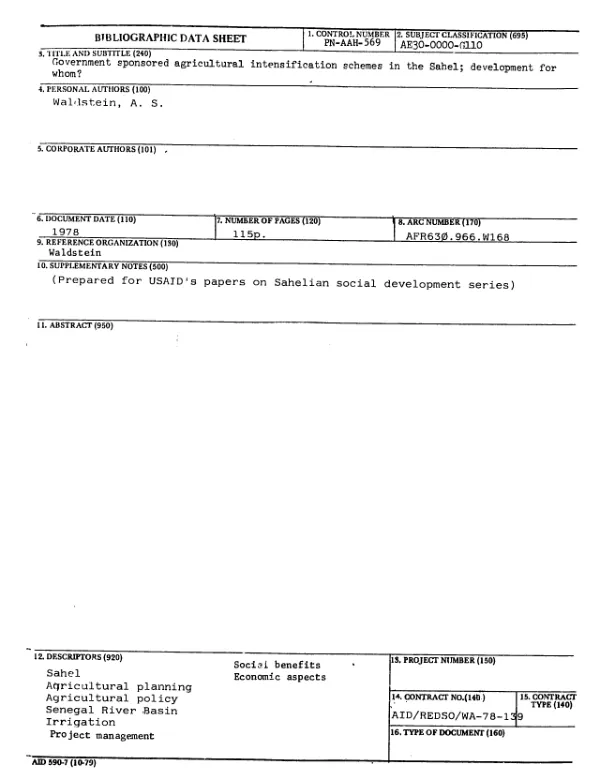
GOVERNMENT SPONSORED AGRICULTURAL INTENSIFICATION SCHEMES IN THE SAHEL; DEVELOPMENT FOR WHOM?
Sign inUSAID DEC
GOVERNMENT SPONSORED AGRICULTURAL INTENSIFICATION SCHEMES IN THE SAHEL; DEVELOPMENT FOR WHOM?
The question, "Development for Whom?", is fundamental to the evaluation of development assistance programs.
WALDSTEIN, ABRAHAM S. · 1970
Sign in to readA free account is required to download.
Abstract
This paper specifically considers the extent of benefits accruing to the rural poor from large-scale agricultural/irrigation projects in the Sahel. The Senegal River Valley has been the locale of a series of such projects, including the Richard Toll Colony, the Gezira Scheme, and the Office du Niger. A common characteristic of these efforts has been the subjugation of the overall welfare of farmers to institutional or national interests, removal of farmers from their native lands, and/or reliance on migrant workers. In one instance, the Mossi (from Upper Volta) were conscripted to work on government farms in the interior delta. During the l960"s, the Mossi left the project in large numbers. Project management never understood the Mossi"s ties to their homeland or their distress over the breakup of extended families and loss of secure positions in a stable society. Another drawback has been the exclusion of the farmers from all decisionmaking processes. In many instances the farmers were forced as tenants to cede their own individual economic interests to the interests of the overall project. In addition, few of these projects have offered the participants incomes substantially greater than otherwise current among farmers in the area. Perhaps the greatest irony is that the quality of diet for the participants has declined -- all while providing burgeoning grain supplies to urban populations. Expulsion of cattle and a sharp reduction in fish production coupled with the increase in human population necessary for field labor are responsible for this decline. The author concludes that the majority of project troubles are related to social management factors; and recommends, among other changes, greater attention to and respect for social ties among the participating groups, representation of the villagers in decisionmaking processes, and increased emphasis upon labor-intensive cultivation.
Related documents