USAID DEC
Grant Progress Report: 2012-Q4
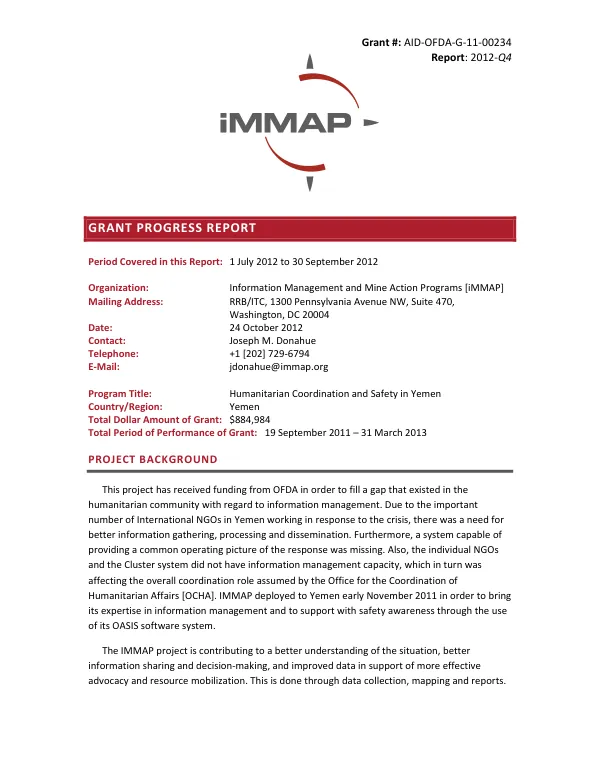
The Humanitarian Coordination and Safety in Yemen project, funded by the Office of U.S.
2012 · 6 pages
Sign in to readA free account is required to download.
Abstract
Foreign Disaster Assistance (OFDA), aims to improve information management and coordination among humanitarian actors in Yemen. The project, implemented by the Information Management and Mine Action Programs (iMMAP), began in November 2011 and is set to conclude in March 2013. The project's primary objective is to provide a common operating picture of the humanitarian response in Yemen, enabling better decision-making and resource mobilization. To achieve this, iMMAP has deployed its OASIS software system, which enables data collection, mapping, and reporting. The system provides a platform for humanitarian actors to share information and access data, improving coordination and response efforts. As of the end of the first year of the project, iMMAP has reached 49 organizations working in the humanitarian field in Yemen, providing them with access to the OASIS data sharing platform and security advisory services. The organization has produced a total of 360 information management products, including 231 maps and 129 reports, dashboards, and snapshots. These products are shared among humanitarian partners, with nearly 130 of them available through the OASIS platform. One of the key highlights of the project is iMMAP's support for the planning of the 2013 Consolidated Appeal Plan (CAP). The organization has been engaged in coordination meetings among United Nations agencies and national and international NGOs to address remaining issues and develop an improved collaborative approach to humanitarian assistance. Geographical priorities have been refined using evidence-based data, leading to proposed scenarios for joint interventions among different sectors. iMMAP has also been working on developing a dashboard product that provides an overview of the situation in a given sector on a single digital page. These dashboards are useful for program managers, advocacy, and resource mobilization specialists. The organization has also provided support to the INGO community, assisting with the cleanup and recoding of security incidents, and has been working with the INGO Forum Safety and Advisory Office (ISAO) to improve the quality of information in its database and enhance its reporting and analytical tools. Looking ahead, iMMAP is anticipating the steps that need to be taken to improve coordination and data collection in the coming months. The organization plans to focus on educating partners on data collection principles and data disaggregation at the collection points, which have proven to significantly improve the quality of data analysis.