USAID DEC
Grant to Environmental Law Institute (an element of AID/Brazil global climate change program)
Sign inUSAID. MISSION TO BRAZIL
Grant to Environmental Law Institute (an element of AID/Brazil global climate change program)
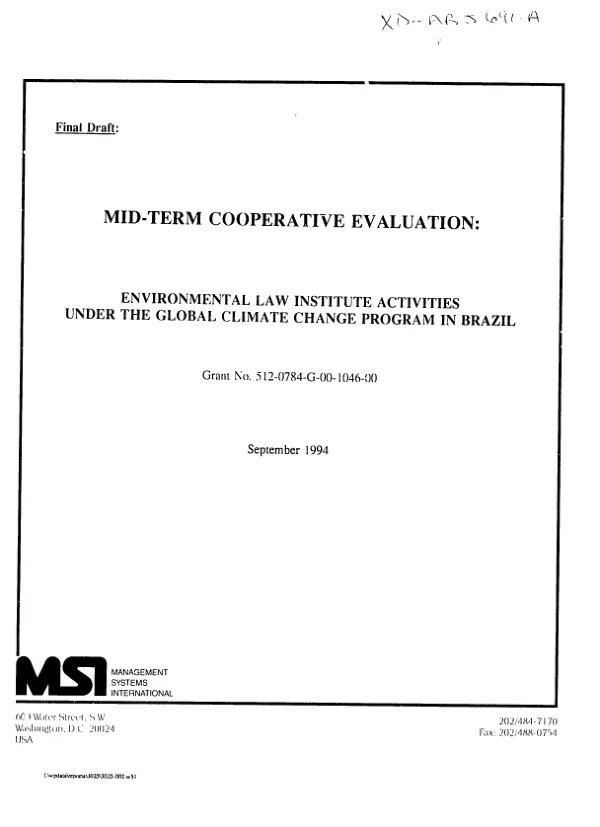
Summarizes attached mid-term evaluation (XD-ABJ-691-A) of a grant to the Environmental Law Institute (ELI) to assist A.I.D."s Global Climate Change (GCC) program in Brazil.
1994
Sign in to readA free account is required to download.
Abstract
The evaluation covered the period 1991-9/94. ELI"s activities are divided into three areas: institutionalization of extractive reserves; environmental assessment training program; and additional training and other legal outreach activities. Under the first component, ELI is directing a study of the extractive reserve system in Brazil. The study, which represents the only systematic review of the status and policy options for development of extractive reserves, has elicited great interest and its quality is known to be high. Its success in promoting institutionalization of the extractive reserve system will depend on how well it is disseminated and incorporated into the ongoing policy debate. The dissemination workshops will play a key role in this regard. The environmental impact assessment (EIA) training program is on track and has promoted broader understanding among government and civil society of the EIA process, and contributed to increased public participation in EIA hearings. Brazilian trainers have replicated ELI course offerings and have taken the lead in revising and updating the materials. The participation of Brazilian trainers is important to trainees because they provide role models and share a common knowledge base. The mix of participants from various governmental and nongovernmental organizations has promoted interchange of ideas and experience and facilitated long-term relationships among individuals at various levels. It is anticipated that this strengthened technical core and increased communication between government and nongovernmental entities will foster checks and balances in the system, limit abuse or neglect of legislation, and strengthen institutional partnerships. In the legal outreach component, ELI has established excellent contacts with a variety of Brazilian governmental and nongovernmental institutions that have facilitated training and collaboration outside of the EIA courses. ELI has also provided Brazilian scholars a good opportunity to gain practical experience; many of these scholars have gone on to careers in they are in a good position to influence Brazilian environmental policy. Some opportunities for productive collaboration with Brazilian grantees have been missed, however, and more could be done to tap ELI"s expertise, particularly in the policy area. Perhaps the most effective way to accomplish this is for ELI to strengthen its contacts with Brazilian GCC grantees in specific research, training, or outreach activities.
Related documents