UNIVERSITY OF WISCONSIN AT MADISON
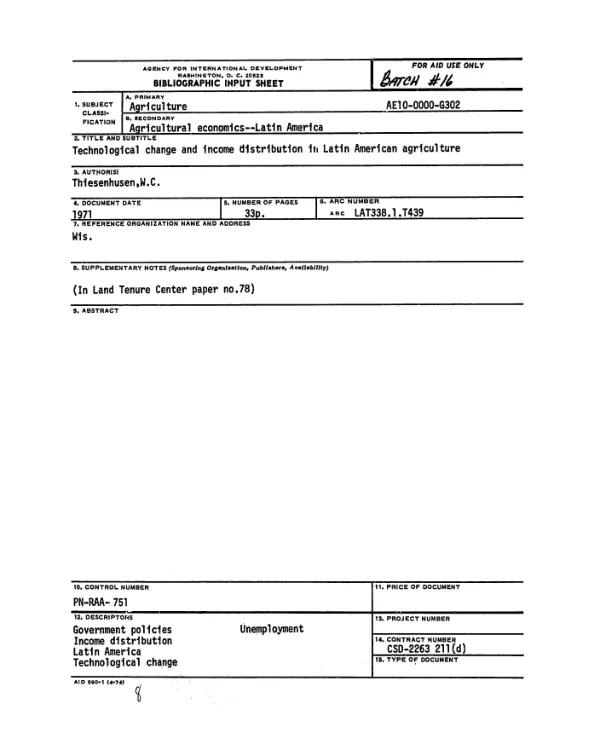
Green revolution in Latin America : income effects and policy decisions
The reasons why the introduction of new technology in agriculture is likely to result in higher unemployment rates and an increasingly skewed income distribution if agriculture"s institutional structure remains unchanged, and the importance of government policies in alleviating these undesirable effects is discussed.
Thiesenhusen, William C. · 1972
Sign in to readA free account is required to download.
Abstract
Where distribution of agricultural resources is highly unequitable, introduction of new technology is likely to increase the income gap between the rich and the poor than in areas where agricultural resources are more evenly distributed. The possible impact of the Green Revolution is traced with regard to four major occupational groupings in Latin American agriculture: (1) the hacienda owner, (2) the micro-plot owner, (3) the renter and share cropper, and (4) the landless laborer, including the resident farmworker. Useful reform schemes are discussed, emphasizing the fact that, whatever the scheme, a technological package of inputs must be made available, so that if correctly used, will markedly raise production. Also, it is equally important that at the same time a supervised credit program is initiated to encourage small farmers to adopt this technology.
Connected topics