USAID DEC
Growth and developmental effects of food shipments under Public Law 480; final report
Sign inIOWA STATE UNIVERSITY OF SCIENCE AND TECHNOLOGY. CENTER FOR AGRICULTURAL AND RURAL DEVELOPMENT
Growth and developmental effects of food shipments under Public Law 480; final report
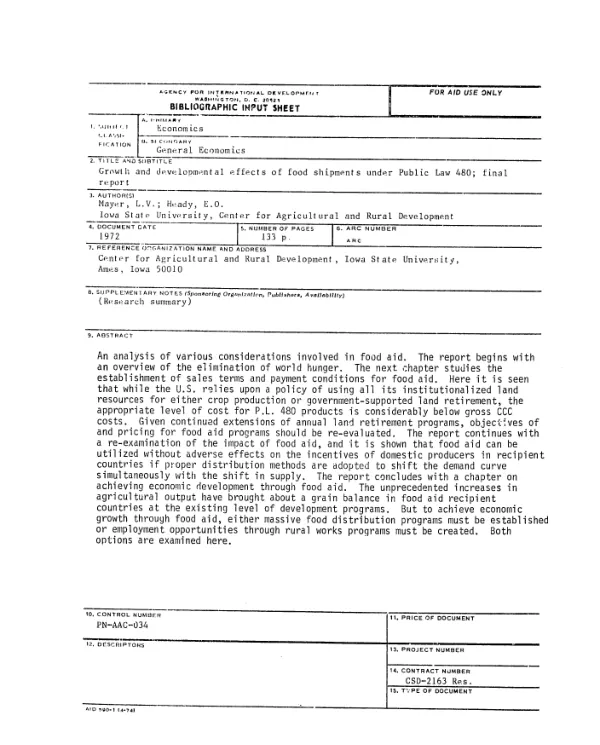
An analysis of various considerations involved in food aid.
Mayer, L. V.; Heady, Earl O. · 1970
Sign in to readA free account is required to download.
Abstract
The report begins with an overview of the elimination of world hunger. The next chapter studies the establishment of sales terms and payment conditions for food aid. Here it is seen that while the U.S. replies upon a policy of using all its institutionalized land resources for either crop production or government supported land retirement, the appropriate level of cost for P.L. 480 products is considerably below gross Commodity Credit Corporation (CCC) costs. Given continued extensions of annual land retirement programs, objectives of and pricing for food aid programs should be re-evaluated. The report continues with a re-examination of the impact of food aid, and it is shown that food aid can be utilized without adverse effects on the incentives of domestic producers in recipient countries if proper distribution methods are adopted to shift the demand curve simultaneously with the shift in supply. The report concludes with a chapter on achieving economic development through food aid. The unprecedented increases in agricultural output have brought about a grain balance in food aid recipient countries at the existing level of development programs. But to achieve economic growth through food aid, either massive food distribution programs must be established or employment opportunities through rural works programs must be created. Both options are examined here.
Related documents
Documents in this collection
 1970
1970USAID DEC
Malnutrition and infection during pregnancy; determinants of growth and development of the child
Open record 1977
1977USAID DEC