INSTITUTE FOR CONTEMPORARY STUDIES. INTERNATIONAL CENTER FOR ECONOMIC GROWTH
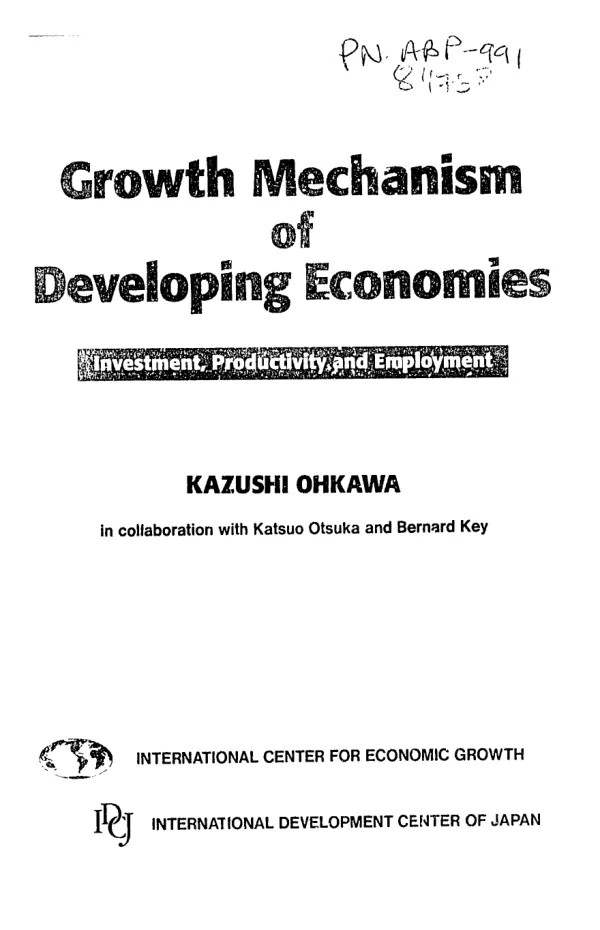
Growth mechanism of developing economies : investment, productivity and employment
The hypothesis is argued that the social capability to absorb knowledge -- at the individual as well as the institutional and organizational levels -- is the key determinant of how effectively a nation uses technology transfers from more developed nations to increase production capacity and economic growth.
Ohkawa, Kazushi; Otsuka, Katsuo +1 more · 1970
Sign in to readA free account is required to download.
Abstract
To this end, the study compares the development histories of successful economies (Western countries and Japan) and those of developing nations in terms of productivity growth, employment, investment and technology, and price and trade structures. Residual growth methodology, as well as cross-sectional and time-series data, are employed in an effort to quantify the elusive term social capability. Findings suggest that the basic factors constraining development are not those conventionally assigned, e.g., shortage of capital, but rather a lack of mechanisms for upgrading social capability. The conclusion is that greater emphasis should be placed on improving a nation"s social capability rather than focusing solely on increasing its productive capacity. Appendices provide further information on Japan"s economic development and on sectoral aspects of residual growth.
Connected topics