HAGLER BAILLY SERVICES, INC.
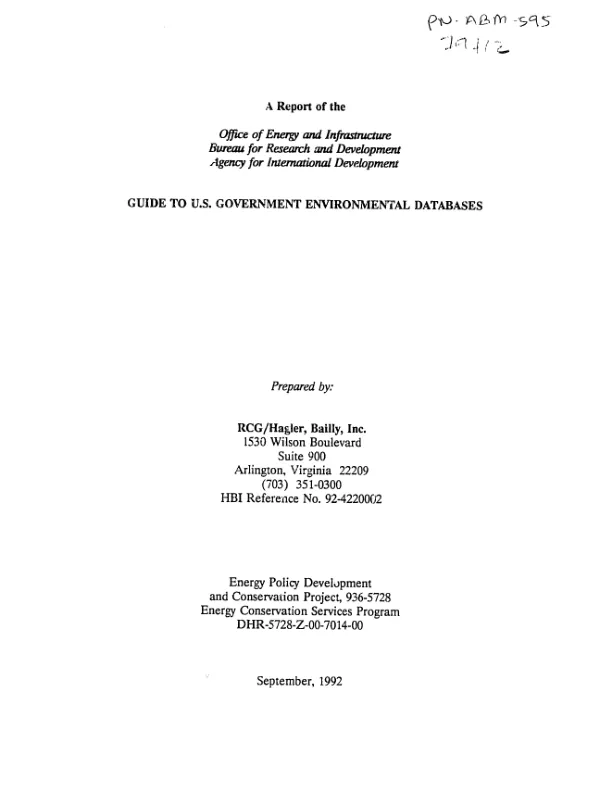
Guide to US government environmental databases
Hundreds of environmental databases and related software have been created by or for the U.S.
1992
Sign in to readA free account is required to download.
Abstract
government. This report provides a quick-reference guide to 111 such databases and analytical tools, chosen for their accessibility, technical level, and potential for USAID application. Highly specialized, scientific databases and databases applicable only to the United States were excluded, as were environmental models which depend on substantial data inputs from other specific models or on raw data sources. Entries provide the following information on the databases: name and host organization, subject matter (general environment, air, hazardous/solid waste, climate change, pesticides/toxic substances, and water), general content, availability and mode of access, cost, and contact person. The databases are grouped into three main categories: (1) general information search and retrieval databases; (2) models, computer-based systems that use data inputs to analyze options and impacts; or (3) primary data databases, sources of specific empirical data with broad applicability. A subset of 16 core databases identified as the most easily accessible and broadest in scope are described separately.
Connected topics