USAID DEC
GUIDELINES FOR AID"S REGIONAL ACTIVITIES IN AFRICA
All A.I.D.
BELCHER, MARJORIE S. · 1970
Sign in to readA free account is required to download.
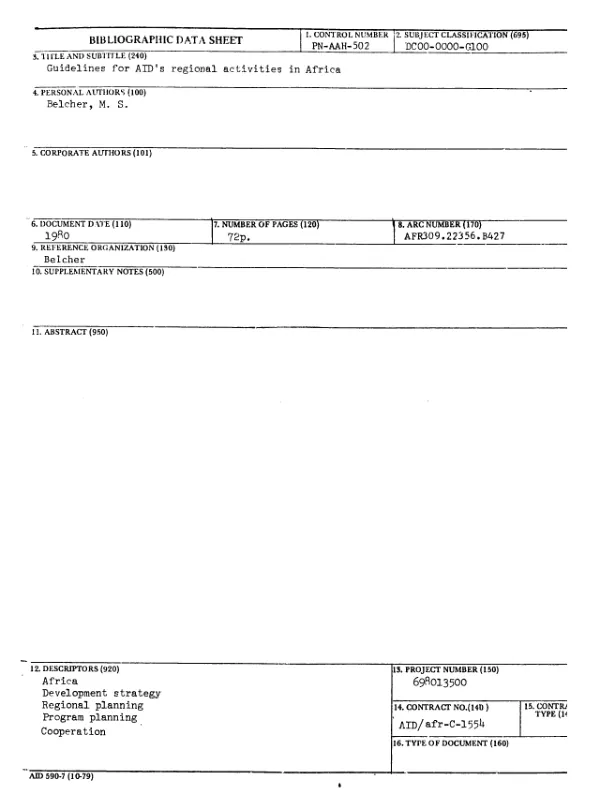
Abstract
regional projects should be consistent with one or more of the following principles: (1) cooperation among two or more countries is essential to success; (2) the project strengthens and increases inter-country cooperation; (3) a regional project is more efficient for administrative purposes; (4) project activities are experimental and promote exchange of experience; and (5) it is more convenient to group a series of small country activities under a single "umbrella" project. These are some of the main findings of a study to develop a strategy for A.I.D."s African regional development (AFR/RA) program. The author notes, however, that many of the present umbrella projects neglect opportunities for exchange of experience and also that, despite excellent opportunities, food and agriculture projects account for only about 12% of A.I.D."s total regional efforts. It is recommended that A.I.D. support to African regional organizations be based on the degree of genuine African support, the extent of real regional activity, effectiveness, receptivity to A.I.D. assistance and cooperation, concern for basic human needs, cooperation with other organizations, and support by other donors. Nine principal types of activity are found appropriate for regional projects. These include participant and in-country training, student and faculty exchanges, attacks on pests and diseases, cooperative research, middle level technical training, distance learning, documentation collection and dissemination, and experimental approaches to common problems. Especially recommended areas of research are family planning; common tropical disease problems; common ecologically-based problems of crops, cattle, and soils; land tenure and use; and the effective use of mass-media for education. Technical training in repair and maintenance for transportation and communications activities is urged, and planners are admonished not to ignore urbanization and increasing underemployment and unemployment. The paper concludes by reviewing the AFR/RA program in various functional areas against these guidelines and assessing future development needs which might be met on a regional basis. Various appendices and a 45-item bibliography (1970-80) are included.
Related documents
![History of USAID/Senegal : [volume I of II]](https://covers.devme.ai/gen/16566.webp)