USAID. MISSION TO ZAIRE
Health and integrated rural development
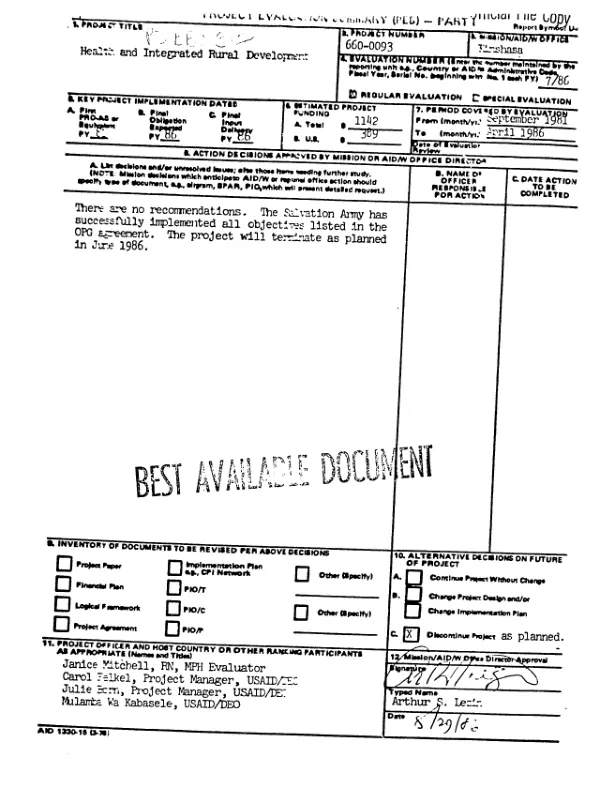
Final PES of an OPG to the Salvation Army to establish a Center of Community Health and Integrated Rural Development in Kasangulu Zone, Bas-Zaire.
Mitchell, Janice; Felkel, Carol · 1986
Sign in to readA free account is required to download.
Abstract
The evaluation covers the period 9/81-4/86 and is based on document review, several site visits, and interviews with USAID/Z and project personnel, local Government of Zaire (GOZ) health officials, and a member of the Basic Rural Health Project (SANRU) staff. In general, the project, which will terminate 6/86, was implemented and is functioning as planned. Although construction delays forced an 18-month project extension, the local availability of construction materials permitted USAID/Z to deobligate $100,000 of the allotted funds. Project funds were used to build the center at Kasangulu and nine satellite clinics. Differences between GOZ health officials and project staff regarding site placement of the satellite clinics delayed decisions on the last sites until 5/84; ultimately, three of them were placed outside Kasangulu zone. It is uncertain whether the population served by the project totals 30,000, as planned: on the one hand, the center and its clinics have a combined target population of about 20,000; on the other, they also serve many people from outside their assigned areas. Village health worker training began at the center in 3/82, and 62 people have been trained to date. The center is also used to provide quarterly refresher training to all nurses. While the maternity center does not serve 4,000, as planned (its capacity is about 2,500), it is in continuous use. Last year, some 1,300 prenatal and 209 family planning visits were made to the maternity, and there were 351 deliveries. Data are insufficient for determining whether morbidity and infant mortality have decreased. Lessons learned are that: (1) villagers are willing to work together and to give of their time and resources for the common good; (2) rural health centers can be self-supporting - six of the 10 Salvation Army centers are financially self-supporting; (3) the problems of clinic placement reinforce the value of needs assessment in project planning and underline the difficulties that can arise with changes in personnel between the planning and implementation stages; (4) maintenance problems with the GMC project truck and the Chevrolet ambulance car call into question the wisdom of buying vehicles for which there is a limited local ability to provide repair and parts; and (5) any replication of a project such as this should be in very close collaboration with SANRU.