USAID. MISSION TO NEPAL
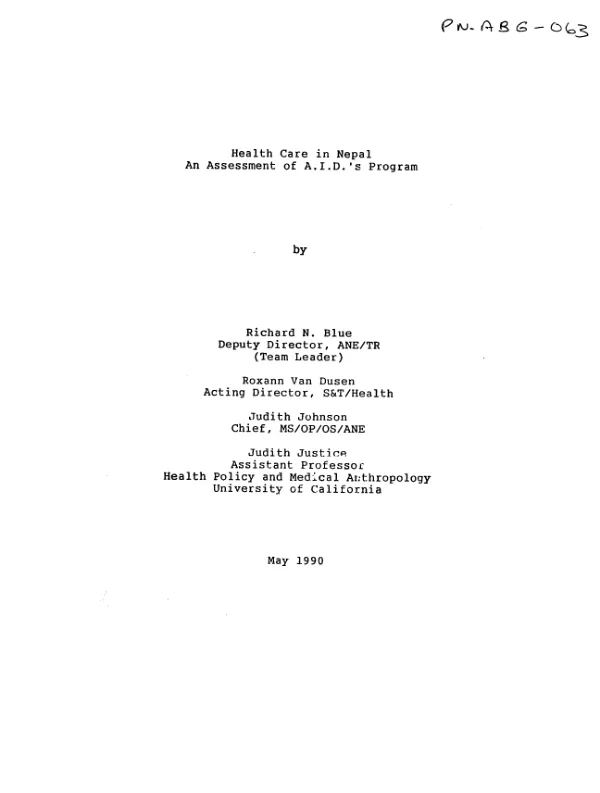
Health care in Nepal : an assessment of AID's program
This report reviews a variety of indicators of health status in Nepal, examines the major policy and institutional themes that have influenced the evolution of the country's health care system, assesses broadly the contribution of A.I.D.
Blue, Richard N.|Van Dusen, Roxann · 1990
Sign in to readA free account is required to download.
Abstract
programs over a 20-year period, and analyzes the impact of the health system. The major conclusions of the report are as follows. (1) Health status has improved -- reflected by increasing life expectancy, declining infant mortality, and the almost complete control of malaria as a major health threat. (2) A.I.D.-supported programs have made a major contribution to these improvements. The most important examples are malaria control, the Expanded Program of Immunization, and diarrheal disease control. (3) The family planning program, which has received significant support from A.I.D. in the past, has not been successful. The contraceptive prevalence rate is only 15%. The program remains overly focused on sterilization rather than offering a broad choice of family planning methods for individuals. (4) Persistence of high levels of female morbidity, fertility, and neonatal disorders and a high incidence of diarrhea, respiratory infections, worms, and skin diseases suggests a cluster of problems which do not respond well to specific interventions. These debilitating health conditions stem from persistent poverty and low levels of female education. (5) The Nepalese health system has been dominated by the government's effort to live up to its promise to provide a reasonable level of health care to all. The gains from this approach are undeniable, particularly the spread of health posts and small hospitals. (6) Institutional weaknesses in the health system persist, including lack of a clear organizational philosophy, bureaucratic rigidity, excessive attention to quantitative targets and reporting, staffing problems, and maintaining adequate and consistent medical supplies. The most important finding is that the demand for health care has outstripped government's ability to supply needed services -- an ability severely limited by inadequate financial resources. (7) The role of private sector health care is poorly defined, in spite of the willingness of many Nepalese to use private, fee- for-service sources. Experience with health insurance or pre- paid drug schemes is very limited and poorly understood by policymakers in the Ministry of Health (MOH). (8) Until now, government efforts to improve health delivery have focused on regionalization and decentralization of bureaucratic decisionmaking in the MOH. Little evidence exists that suggest these efforts are more than formal changes in the organizational chart. However, A.I.D.'s efforts to strengthen decentralization are a positive step. (9) The very recent establishment of a corps of women community health volunteers offers some hope that some expression of local demands for improved medical care will be felt by the government. There is a danger that this corps will be incorporated into the system as a new "bottom rung" of the health bureaucracy. A.I.D. support of women's involvement should focus on improving their effectiveness and autonomy. The advent of a new, potentially democratic government affords an opportunity for Nepal to undertake a reexamination of its health care policies, programs, and organization. Since sufficient progress has been made in laying down a basic infrastructure, the present time may be an excellent opportunity to focus on the quality, efficiency, and financial sustainability of both public and private health care in the country. As a still respected development institution in Nepal, A.I.D. has a unique opening to help the new government chart a fresh approach to health care. This opportunity should not be lost. (Author abstract)
Related documents