USAID. MISSION TO CAMEROON
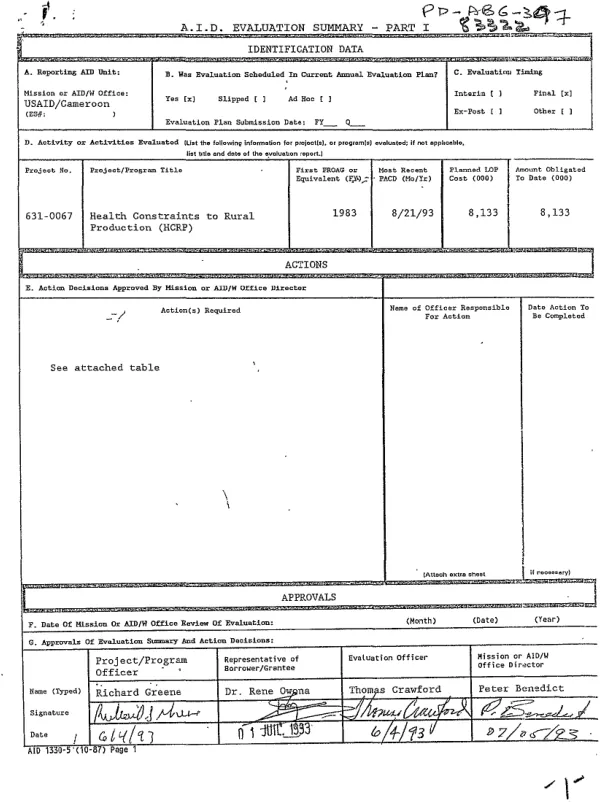
Health constraints to rural production (HCRP)
Summarizes final evaluation (unattached) of Phase II (1990-8/93) of a project to develop and test a model for schistosomiasis control and prevention in the Kaele area of Cameroon"s Far North Province.
1993
Sign in to readA free account is required to download.
Abstract
The project has done an admirable job of developing a schistosomiasis control program and is providing curative, preventive, and promotive care which is cost-effective, socially acceptable, and environmentally sound. All three project components were successful. The project integrated diagnosis and treatment of schistosomiasis into almost all health facilities in the Kaele and Moutourwa subdivisions, and trained 55 health center workers, who are regularly supervised by divisional level personnel. This should facilitate the launching of community co-managed and co-financed health centers, especially in light of the recent impetus provided by the Ministry of Health toward creating functional health districts along with Save the Children"s intention under USAID/C"s Reform of Health Delivery Systems (RHDS) Project to support the creation of the health district of Kaele. The health education component trained 270 schoolteachers to provide schistosomiasis information to students. Through these efforts, student knowledge of the connection between the snail vector and the disease has increased from 16% to 76%. In some cases, students carried this knowledge back to adults in the village, but more effort at the community level is needed. The project has demonstrated that a simplified methodology for controlling the snail vector can be implemented by the population with TA from a divisional (or health district) supervisor. There has been a dramatic decrease in the population of snails during the transmission season. However, infection rates in test villages (which add snail control to treatment and education) are only marginally lower than those in villages with treatment and health education alone. Cost recovery for laboratory testing and treatment is well established, and a system to resupply drugs and laboratory reagents to health facilities has been put in place by the RHDS project. Cost recovery for snail control has not yet been attempted, however, as it is only possible in villages having both significant interest and the potential to mobilize funding. Major recommendations are to: (1) develop a transitional action plan to prepare for the integration of schistosomiasis activities into the Kaele health district; (2) revise the existing schistosomiasis control manual for health workers; and (3) expand the roles of teachers and health district supervisors in schistosomiasis education in the schools.
![ITN [insecticide treatment nets] national social marketing project in Cameroon : midterm evaluation report](https://covers.devme.ai/gen/5004.webp)
![ITN [insecticide treatment nets] national social marketing project in Cameroon : midterm evaluation report](https://covers.devme.ai/gen/85803.webp)