USAID DEC
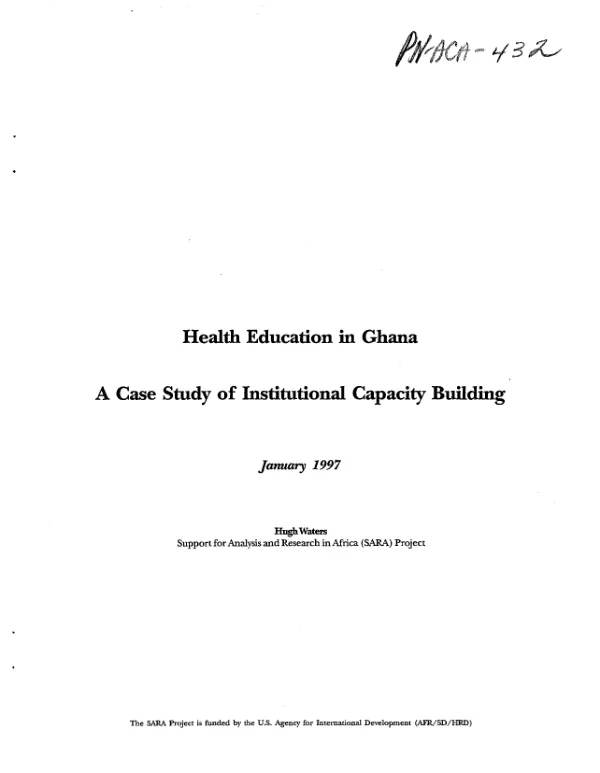
Health education in Ghana : a case study of institutional capacity building = Education sanitaire au Ghana -- le reinforcement des capacites institutionnelles : une etude de cas
Sign inACADEMY FOR EDUCATIONAL DEVELOPMENT, INC. (AED)
Health education in Ghana : a case study of institutional capacity building = Education sanitaire au Ghana -- le reinforcement des capacites institutionnelles : une etude de cas
USAID"s Health and Family Planning Information Program and its successor, the Ghana Family Planning and Health Project, have strengthened the capacity of the Ministry of Health"s (MOH) Health Education Unit (HEU) to promote family planning, and subsequently to conduct information, education, and communication (IEC) campaigns related to diarrhea, malaria, and HIV/AIDS prevention and control.
Waters, Hugh · 1997
Sign in to readA free account is required to download.
Abstract
As a result, the HEU now has the technical and administrative capacity to lead a coordinated national campaign as well as the credibility to work with other national programs such as HIV/AIDS Control and Prevention programs -- which in other countries have bypassed HEUs and conducted their own IEC activities. This paper discusses the reasons for the Ghana HEU"s success. Two strategies emerge as particularly important: human resource development and partnering. At the central level, the development of a dedicated, skilled 10-person HEU team enabled successful management of diverse health education activities and decentralized campaigns. At regional and district levels, recruitment, training, and empowerment of health education officers and health management teams led to successful campaigns in three regions. The leadership demonstrated by the HEU and MOH in forming collaborative relationships with other ministries, NGOs, and the private sector was a key aspect of institutional strengthening, especially for family planning IEC. Other lessons learned are as follows. (1) That the key personnel in these efforts were officials within the MOH led to a sense of ownership on the part of the government. (2) Continuity of personnel, both within the HEU and among expatriate advisors, was another essential element to the HEU"s success. (3) Expanding from pilot projects is a time consuming and expensive process. The success of family planning campaigns in three regions during 1990-1993 depended on extensive training and research which began in 1987. However, research in one area of a country does not always provide the background information needed to implement activities in other areas of the country. (4) A one-week training course for service providers may not provide enough time to cover diverse topics; on the other hand, it is expensive to bring health workers together for longer periods. Distance techniques such as use of cassettes and toolkits may provide a solution. (5) Focusing on the service provider as a common theme in different messages (e.g., for malaria and AIDS) provides a comprehensible connection for the public. In some situations, however, direct association with other national health priorities may be a risky strategy.
Related documents
Documents in this collection
 1996
1996USAID DEC
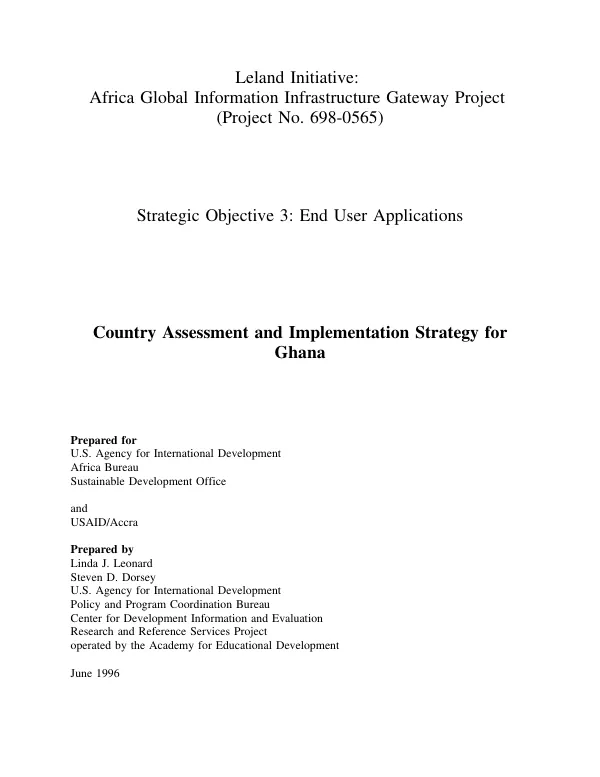
Leland initiative : Africa global information infrastructure gateway project (project no. 698-0565) -- strategic objective 3 : end user applications -- country assessment and implementation strategy for Ghana
Open record![CDD [control of diarrheal diseases] and ARI [acute respiratory infection] programs in sub-Saharan Africa : redefining their roles in a changing context = Programmes de LMD [lutte contre les maladies diarrheiques] et IRA [infections respiratoires aigues] en Afrique subsaharienne : redefinir leurs roles dans un contexte changeant](https://covers.devme.ai/gen/65172.webp) 1997
1997USAID DEC