CAMP DRESSER AND MCKEE, INC. (CDM)
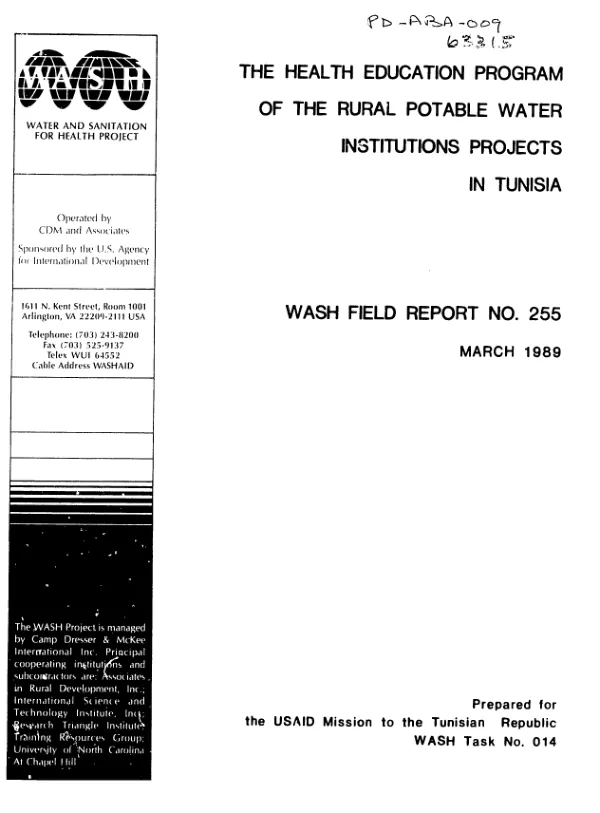
Health education program of the rural potable water institutions project in Tunisia
Evaluates health education activities under the rural potable water project in Tunisia.
Pine, Pamela · 1989
Sign in to readA free account is required to download.
Abstract
Findings: (1) The Regional Health Education Team (RHET) has largely carried out its planning for the school health component. (2) Sixteen of the twenty communities selected for the first year of activity have taken steps to reduce water-related diseases through health education. (The animatrices in the other four communities dropped out of the program during the year for various reasons.) (3) The program has attracted regional, national, and international attention because of its innovative approach and record of success. (4) Progress within the school health program, the major focus of this consultancy, has been slow, but steps to move the program along have been taken. (5) The water user associations (WUA's) have not been made responsible for procuring funds to support the initial group of animatrices, nor have community development project funds been secured for this purpose. (6) The major problems reported in the last consultancy, as well as some others, remain unresolved. Training of Regional Health Education Team (RHET) members in the U.S. has not yet occurred. RHET's request for "argent d'encouragement" has gone unheeded. Inadequate staffing and the lack of a vehicle are hampering RHET's work. Funding for the project when AID support ceases in 1991 is still undetermined. Conclusions: (1) RHET and supporting personnel should be able to carry out most of the planned activities, given additional staffing, continued training, and support. (2) The community and individuals from the various government agencies have shown the capacity to work toward the goals of the program and ensure its viability. (3) More frequent and closer collaboration is needed between RHET, those providing TA, and USAID/T to ensure the transfer of technical expertise, follow-through, and general support. (4) It may have been unrealistic for USAID/T to assume that communities would be willing and able to assume responsibility for development programs after one year. (5) Community health education programs are unlikely to be sustained if the work of the animatrices in the original sixteen communities is discontinued. (Author abstract)