PRINCETON UNIVERSITY
Health, nutrition, and income distribution
When the process of economic growth bypasses the lowest income groups, particularly in rural areas, it is not surprising that little improvement in health and nutrition occurs.
Oftedal, O. T.; Levinson, F. J. · 1970
Sign in to readA free account is required to download.
Abstract
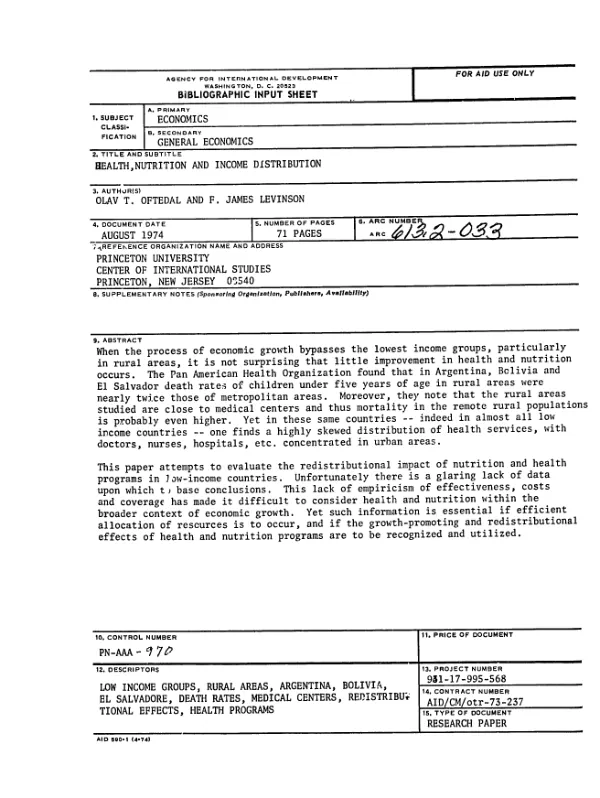
The Pan American Health Organization found that in Argentina, Bolivia and El Salvador death rates of children under five years of age in rural areas were nearly twice those of metropolitan areas. Moreover, they note that the rural areas studied are close to medical centers and thus mortality in the remote rural populations is probably even higher. Yet in these same countries -- indeed in almost all low income countries -- one finds a highly skewed distribution of health services, with doctors, nurses, hospitals, etc. concentrated in urban areas. This paper attempts to evaluate the redistributional impact of nutrition and health programs in low-income countries. Unfortunately there is a glaring lack of data upon which to base conclusions. This lack of empiricism of effectiveness, costs and coverage has made it difficult to consider health and nutrition within the broader context of economic growth. Yet such information is essential if efficient allocation of resources is to occur, and if the growth-promoting and redistributional effects of health and nutrition programs are to be recognized and utilized.
Connected topics