USAID DEC
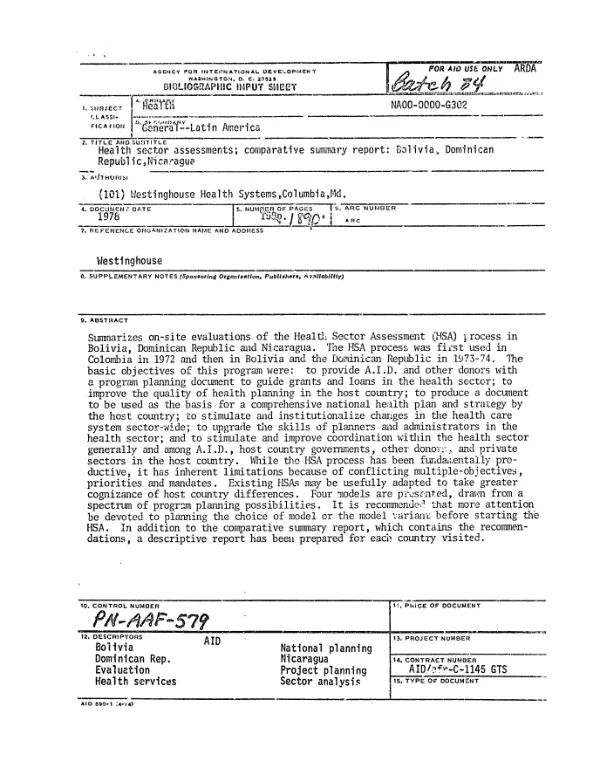
HEALTH SECTOR ASSESSMENTS; COMPARATIVE SUMMARY REPORT : BOLIVIA, DOMINICAN REPUBLIC, NICARAGUA
Sign inWESTINGHOUSE HEALTH SYSTEMS, INC.
HEALTH SECTOR ASSESSMENTS; COMPARATIVE SUMMARY REPORT : BOLIVIA, DOMINICAN REPUBLIC, NICARAGUA
Summarizes on-site evaluations of the Health Sector Assessment (HSA) process in Bolivia, Dominican Republic and Nicaragua.
1970
Sign in to readA free account is required to download.
Abstract
The HSA process was first used in Colombia in 1972 and then in Bolivia and the Dominican Republic in 1973-74. The basic objectives of this program were: to provide A.I.D. and other donors with a program planning document to guide grants and loans in the health sector; to improve the quality of health planning in the host country; to produce a document to be used as the basis for a comprehensive national health plan and strategy by the host country; to stimulate and institutionalize changes in the health care system sector-wide; to upgrade the skills of planners and administrators in the health sector and to stimulate and improve coordination within the health sector generally and among A.I.D., host country governments, other donors, and private sectors in the host country. While the HSA process has been fundamentally productive, it has inherent limitations because of conflicting multiple objectives, priorities and mandates. Existing HSA"s may be usefully adapted to take greater cognizance of host country differences. Four models are presented, drawn from a spectrum of program planning possibilities. It is recommended that more attention be devoted to planning the choice of model or the model variant before starting the HSA. In addition to the comparative summary report, which contains the recommendations, a descriptive report has been prepared for each country visited.
Related documents
![LAC regional -- health priorities [project] (598-0825) : maternal mortality initiative](https://covers.devme.ai/gen/65722.webp)