ACADEMY FOR EDUCATIONAL DEVELOPMENT, INC. (AED)
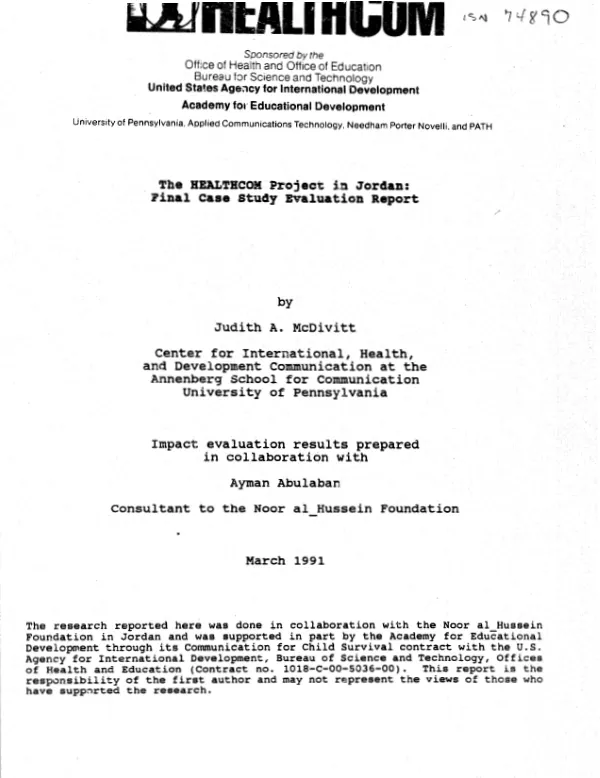
HEALTHCOM project in Jordan : final case study evaluation report
Ex post evaluation of a project to implement a communications campaign on child survival in Jordan and to institutionalize the communications methodology within Jordanian institutions.
McDivitt, Judith A.|Abulaban, Ayman · 1991
Sign in to readA free account is required to download.
Abstract
The evaluation covers the period 7/87-7/89. The project developed a high-quality, effective communication program, even though administrative and technical delays consumed 9 of the project's 24 months. The program addressed child- spacing and breastfeeding and developed radio and television messages on these topics. The breastfeeding messages were broadcast in 1989 and 1990, but the child-spacing spots were never aired because of their controversial nature. Exposure to the breastfeeding media campaign was high; 94% of mothers reported having heard the song which was played in the radio and television spot, while 89% and 69% of mothers reported having heard, respectively, the television and radio spots. Initiation of breastfeeding within 6 hours after birth increased significantly during the campaign, but only among mothers who gave birth in a public hospital or at home. Knowledge about correct breastfeeding initiation increased to very high levels, while results concerning awareness of supplementation were more mixed. The contractor -- the Academy for Educational Development (AED) - - provided on-the-job training to staff at the Noor al Hussein Foundation, the primary implementing agency. Formal training activities, conducted for Foundation staff and other institutions, including the Ministry of Health (MOH), included 5 workshops on the communications methodology, a national seminar on breastfeeding, and special sessions to train focus group leaders. Parts of the methodology (pretesting, use of focus groups and formative research) have been adopted by participants, but only two people, both project staff at the Foundation, understand the methodology as a whole, and one has already left the Foundation. This weakness is due to the project's short operational timeframe and the insufficient amount of formal training. Although AED expected learning to take place primarily through on-the-job training, formal training was a priority among participants. Attempts to form a coordinated health communication team with representatives from various institutions were unsuccessful, as a strong cooperative spirit did not develop, again largely due to time limitations. Most project participants felt the project should have been implemented through the MOH. Although the Foundation, being outside the bureaucracy, offered flexibility, the MOH could have ensured greater continuity and sustainability. The major lesson learned is the importance of local participation in choosing the topics to be addressed in a communications project. Child spacing seems to have been chosen primarily by USAID/J and AED, who deemed it appropriate for a communication campaign in Jordan. By contrast, the Foundation and the MOH found the subject too controversial. As an institution linked to the queen, the Foundation in particular was very careful about not promoting controversial activities.