USAID DEC
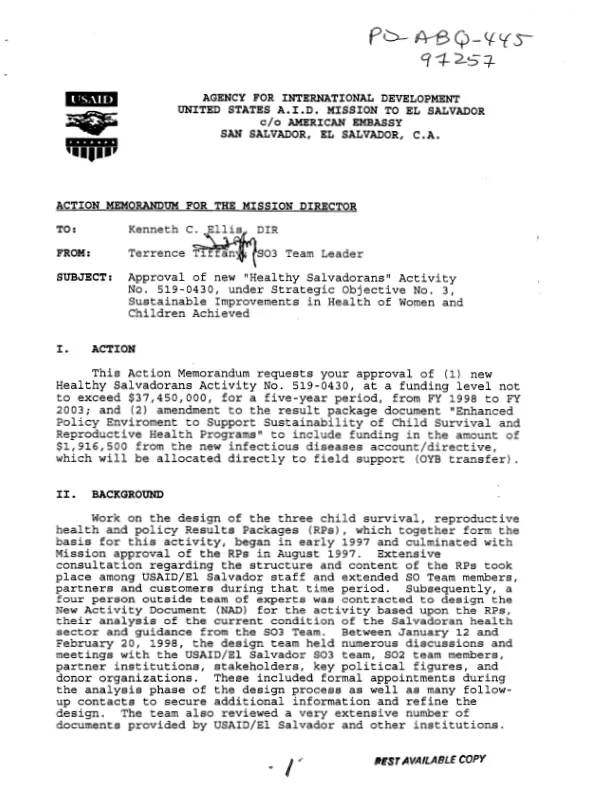
Healthy Salvadorans (Salvadorenos saludables, SALSA) : activity no. 519-0430 -- new activity document (NAD)
Sign inUSAID. MISSION TO EL SALVADOR
Healthy Salvadorans (Salvadorenos saludables, SALSA) : activity no. 519-0430 -- new activity document (NAD)
Activity to improve the quality and accessibility of child survival (CS) and reproductive health (RH) services for the Salvadoran rural poor in underserved areas and to improve related policy and institutional systems (SALSA activity).
1998
Sign in to readA free account is required to download.
Abstract
Efforts will focus on health promotion, education, and preventive care actions, and will stress community participation. CS interventions, which will be closely coordinated with the Mission"s water and sanitation project, will aim at reducing diarrheal disease, respiratory infections, and other common childhood illnesses, and improving nutritional status. Additionally, research will be conducted on poorly understood causes of infant and child morbidity and mortality such as birth defects and congenital abnormalities, as well as violence, abuse, and accidents. Integrated management of childhood diseases (IMCI) will be the principal long-term strategy employed. SALSA will also support specific parallel CS interventions now being carried out by the Ministry of Health (MOH) and NGOs that have proven their effectiveness, such as nutrition education and health promoter training. RH activities will focus on four areas. (1) In the area of pre-natal, delivery, and post-partum care, SALSA will assist the MOH and NGOs in: (a) training primary health care providers (physicians, nurses, auxiliaries) in early detection of obstetric risks and pre- and post-partum natal control (including breastfeeding and family planning [FP] promotion), as well as in safe childbirth techniques (including identification and treatment of high risk cases and encouraging women and especially adolescents to have deliveries attended by trained personnel); (b) training health promoters and midwives how to counsel mothers and families regarding early detection of pregnancy, proper care, and referral to health and FP services (this training will be closely integrated with CS activities); and (c) community education and training on the importance of RH activities implemented by primary health units and promoters, with particular emphasis on reaching men in their capacity as community and family decisionmakers. (2) Areas of support for FP are likely to include training for primary care personnel (including midwives) in such areas as FP education and counseling, as well as community information, education, and communication (IEC) activities to promote behavior change in the areas of RH and FP; in both instances, special emphasis will be placed on serving vulnerable populations such as adolescents. SALSA will also provide contraceptives to FP NGOs and to the MOH on a declining basis over the life of the project. (3) In the area of sexually transmitted diseases (STDs) and HIV/AIDS, SALSA will: (a) train MOH primary care physicians and nurses in HIV/AIDS counseling and in early detection, management, and treatment of STDs, using the syndromic approach proposed by PAHO; (b) provide TA to the MOH for improving epidemiological surveillance of STDs and HIV/AIDS through the first primary level of health services; and (c) provide technical and financial assistance to the MOH to implement related community-level educational programs. These activities will complement in-country activities of the HIV/AIDS project in Central America (PASCA -- 5960179). (4) SALSA will also support: (1) studies and operational research on such subjects as barriers to FP use and measures to prevent STD/HIV infection; (2) the next (year 2002) round of the National Family Health Survey (FESAL); and (3) reestablishment of the National RH Committee, to coordinate public, private, and donor RH and FP efforts. The final component will help develop a more appropriate legal and policy framework in four areas: (1) development of a legislative and regulatory framework, along with policies and budgetary priorities favorable to improved maternal and child health care; (2) reform and modernization of the health care delivery system; (3) policy research to support reform and modernization of the health system and of health service delivery; and (4) coordination among key health sector decisionmakers and among donor agencies to enhance effective use of health resources.
Related documents