USAID DEC
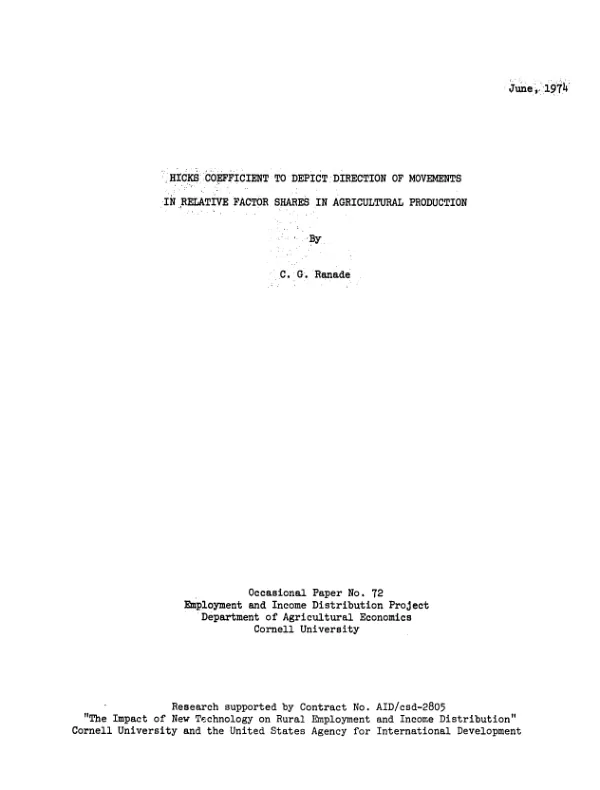
Hicks coefficient to depict direction of movements in relative factor shares in agricultural production
Sign inCORNELL UNIVERSITY
Hicks coefficient to depict direction of movements in relative factor shares in agricultural production
The Hicks coefficient is the criterion of changes in income distribution when the agricultural production is subject to constant returns to scale and when the factor-inputs are paid their marginal physical productivities.
Ranade, C. G. · 1970
Sign in to readA free account is required to download.
Abstract
Meade did arrive near to the solution, however his results using the direct elasticity of substitution are not easy to interpret. Next, the criterion that Samuelson suggested, while criticizing others, is indeed easy to handle. However, Samuelson"s criterion is not useful in the case of the multipurpose analysis; for example, if one is interested in linking simultaneous changes in the supplies of more than one input with the relative shares of the factors involved in the agricultural production. The work of Sato and Koizumi moved a step beyond the earlier attempts, however they did not explore the usefulness of the partial elasticity of complementarity as a criterion in the most general case where the supply of all inputs changes. Actually, the Hicks coefficient and the partial elasticity of complementarity are very similar except for the fact that one is reciprocal to the other. Thus, this paper establishes that the partial elasticity of complementarity is also the criterion of changes in relative factor shares. Our analysis on the CES production functions showed that except for the Uzawa Type I case there may not always be one-to-one correspondence between the Hicks coefficient and the partial and direct elasticities of substitution.