USAID. MISSION TO INDIA
Hill areas land and water development project
Summarizes midterm evaluation (PD-AAY-965) of a project to create new irrigated land in India"s Himachal Pradesh State and improve water management through afforestation, erosion control, horticulture, and community-based management.
1989
Sign in to readA free account is required to download.
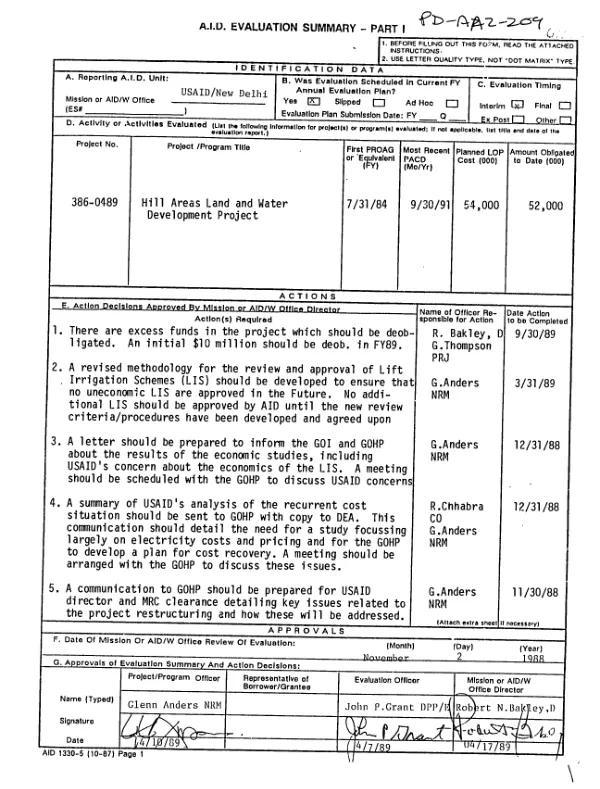
Abstract
The evaluation covers the period 7/84-3/89. Although initial implementation was slow, there is clear evidence of significant progress towards project objectives. The project has had a major impact on irrigation design, and the potential also exists for broader, high-impact efforts in related watershed forestry and conservation interventions. However, there has been little institutionalization of these changes due to very slow progress in technical training, socioeconomic analysis, technology adaption, and system research activities. In terms of economic viability, the tube well, tank, and flow schemes have been effective, but the high-lift pump systems (which represent an increasing proportion of project schemes) are questionable due to high capital, recurrent costs, and possibly overly optimistic assumptions on cropping patterns. The recurrent costs will become increasingly burdensome to the Government of Himachal Pradesh (GOHP), and cost recovery measures (e.g., user fees) should be implemented immediately. A more rational system for selecting project sites would also improve the economic viability of individual schemes as well as returns to A.I.D."s overall investment. The current system lacks both comprehensive technical criteria and land and water resource plans. Although farmer participation in subproject design and implementation is limited, awareness of the need for such participation has greatly increased among GOHP officials. Training and TA activities for GOHP staff were initiated much later than planned and need to be intensified. In general, the project is substantially overfunded in relation to the GOHP"s limited implementation capacity. Currently, no institutions exist in the State which can adequately collect and analyze the data necessary for development planning or fulfill technical responsibilities in mountainous areas. Therefore, it is recommended that the project be extended, albeit with a reduced number of schemes and increased emphasis on planning, training, applied research, and feedback monitoring. According to USAID/I, negotiations with the GOHP on restructuring the project have been hampered by the Pro-Ag"s failure to require testing of schemes for economic viability. On the positive side, overall economics for the project - which has a notable development potential both economically and environmentally - should be improved by a major fruit and vegetables processing project being undertaken in North India by the U.S. Pepsi Cola Co. with substantial inputs expected from Himachal Pradesh.