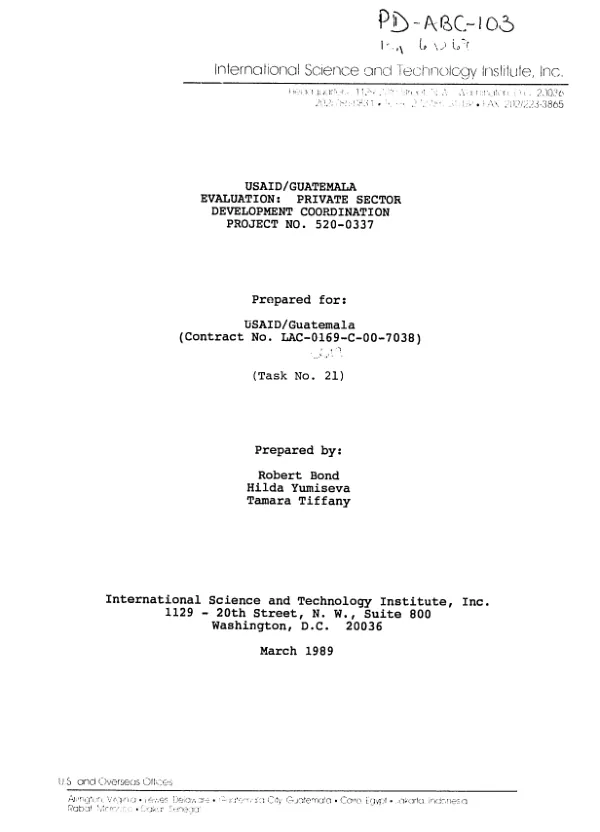
INTERNATIONAL SCIENCE AND TECHNOLOGY INSTITUTE, INC. (ISTI)
Honduras : FIDE special debt restructuring fund evaluation
Evaluates a project component to provide assistance to Honduran nontraditional exporters through a special debt restructuring fund (SDRF).
Jarquin, Rene · 1989
Sign in to readA free account is required to download.
Abstract
The evaluation focuses on credit provided via the fund to two private exporting companies: Maderas Hondurenas Procesadas, S.A. (MAHPROSA) and Derivados de Maderas S.A. (DERIMASA). The evaluation covers the period 9/85-8/89. Performance in both companies is improving, but the SDRF's role in these improvements is negligible. In fact, the SDRF seems to have benefited intermediary banks more than the companies in need. For example, Banco de Occidente was MAHPROSA's major creditor, yet had no commitment to assist the company. In both cases, creditor banks received payments in advance without any coordinated arrangement for additional and simultaneous financial support. In both companies, too much SDRF financing was assigned to pay bank debts rather to provide fresh working capital or acquire key fixed assets. The impact of SDRF was also limited by problems with the Central Bank's revolving credit fund, designed to complement SDRF credit. The two mechanisms are not well coordinated, and neither is very efficient. The loans to be provided under the revolving line were obtained either with delay or not at all, while very few SDRF funds were approved and disbursed, despite a high initial demand. With regard to socioeconomic impact, results are mixed: SDRF seems more efficient in expanding exports, the revolving line more cost-effective in generating employment. Vague and inadequate SDRF regulations regarding the types of debt eligible for restructuring have permitted questionable types of financial restructuring. In the case of MAHPROSA, for example, this led to land acquisition and the consideration of loans whose maturities were scheduled for more than two and three years in the future. Further, in the case of both firms the applications for and approval of SDRF credit were not supported by adequate or appropriate feasibility studies. While there was financial information provided by appraisal documents, there were no restructuring guidelines for the preparation and evaluation of a rehabilitating or a restructuring subproject. Management of the SDRF by the Foundation for Investment and Export Development (FIDE) has been constrained by USAID/H's apparent lack of interest in the fund. USAID/H has decided to use half of the fund's original resources to finance free-zone parks and plans to eliminate FIDE's role in assessing borrower eligibility for both eligibility for both the SDRF and the Central Bank credit lines. A major recommendation is that the SDRF be redesigned to provide companies the financial support they require for nontraditional exports.
Related documents
![Small business II project, Honduras : midterm evaluation of the ANDI/PYME [Asociacion Nacional de Industriales/Pequena y Micro Empresa] component](https://covers.devme.ai/gen/14429.webp)