USAID DEC
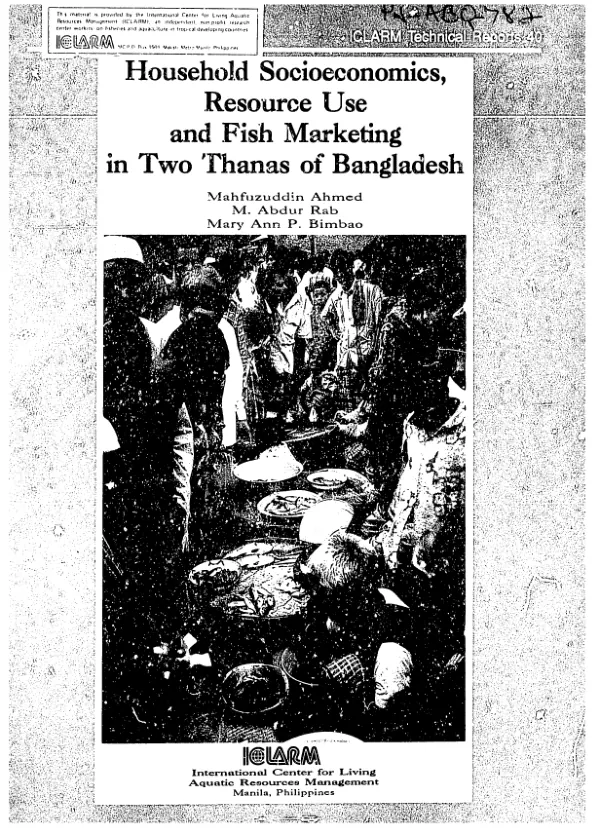
Household socioeconomics, resource use and fish marketing in two thanas of Bangladesh
Sign inINTERNATIONAL CENTER FOR LIVING AQUATIC RESOURCES MANAGEMENT (ICLARM)
Household socioeconomics, resource use and fish marketing in two thanas of Bangladesh
A socioeconomic survey was carried out on a sample of 333 households from among the owners and operators of small waterbodies (ponds and ditches) in two subdistricts or thanas: Kapasia (the target area for development of aquaculture) and Sreepur (the control area with no development initiative for aquaculture) in the district of Gazipur, Bangladesh.
Ahmed, Mahfuzuddin; Rab, M. Abdur +1 more · 1970
Sign in to readA free account is required to download.
Abstract
The survey also provides information about fish markets in the two thanas. Fish traders in 21 village markets -- 15 from Kapasia and 6 from Sreepur -- were surveyed. Comparison of land and assets as well as income of the households indicated very little variation between the two thanas as far as the owners and operators of small waterbodies are concerned. Similarly, education, occupation, consumption pattern, and resource use pattern of these households differed only slightly. It was also revealed that these persons enjoyed a higher socioeconomic status than the rest of the community. In both thanas, pond owner and operator households consumed relatively more of fish and other animal proteins than the national average. On the average, fish represented nearly 70% of the total consumption of animal protein by the respondent households in both the thanas, quite similar to the national average. However, of the total household consumption of fish, on-farm fish represented only 32% in Kapasia and 22% in Sreepur. The log-linear estimate of demand for fish showed that per capita household demand for fish has low income elasticity (0.29). Also, market demand for fish was negatively related to the availability of fish from on-farm sources. Aside from conventional resources such as land, labor, animal, and capital, the respondent households generated a substantial amount of by-products and wastes, such as rice bran, cow dung, poultry manure, and kitchen wastes. Apart from poultry manure, most was used for animal feed or crop fertilizer. Virtually none was used in aquaculture. About 50% of the area under pond dikes in Kapasia and 23% in Sreepur are currently used for gardening, animal grazing, seedbeds, and plant nurseries. Aquaculture techniques, input-use pattern, and management were largely unscientific. Overstocking of fingerlings, low levels of both on-farm and off-farm inputs, and irregular stocking and harvesting were the general features of the existing aquaculture in both thanas. Rural fish markets still receive most supplies from capture fisheries sources. Aquaculture products in the market were mainly Indian major carps, comprising 38% of the total supply. Among the exotic species, Chinese carp (19%) and common carp (Cyprinus carpio) (14%) were dominant. Nile tilapia (Oreochromis niloticus) and silver barb (Puntius gonionotus) were totally absent from the markets. Fish trading is the principal occupation of most of the traders (83% in Kapasia, 93% in Sreepur) in the village markets in both thanas. None of the fish sellers were pond owners or operators selling their produce themselves. Market margins of most of the capture fishery species were generally higher than those of the farmed species. Introduction of aquaculture in the rural areas will increase on-farm consumption of fish. But the benefits of improved aquaculture technology will accrue mainly to the owners and operators of small waterbodies whose present socioeconomic conditions are better than the rest of the rural population. It might, therefore, be necessary to promote low-cost technologies for aquaculture as well as to provide institutional and policy support to enable poor and landless people to get access to waterbodies and adopt aquaculture. (Author abstract)
Related documents
Documents in this collection
 1970
1970USAID DEC
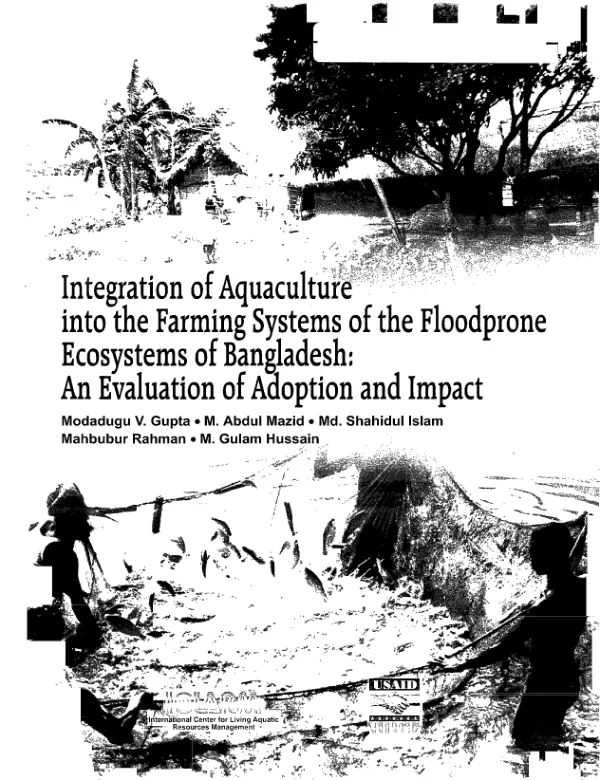
Integration of aquaculture into the farming systems of floodprone ecosystems of Bangladesh : an evaluation of adoption and impact
Open record 2017
2017USAID DEC