USAID. MISSION TO EL SALVADOR
Housing guarantee program (marginal community improvement project)
Evaluates Housing Guaranty (HG) program for low-income urban populations in El Salvador.
Brady, Charles; Caceres, Mario +1 more · 1970
Sign in to readA free account is required to download.
Abstract
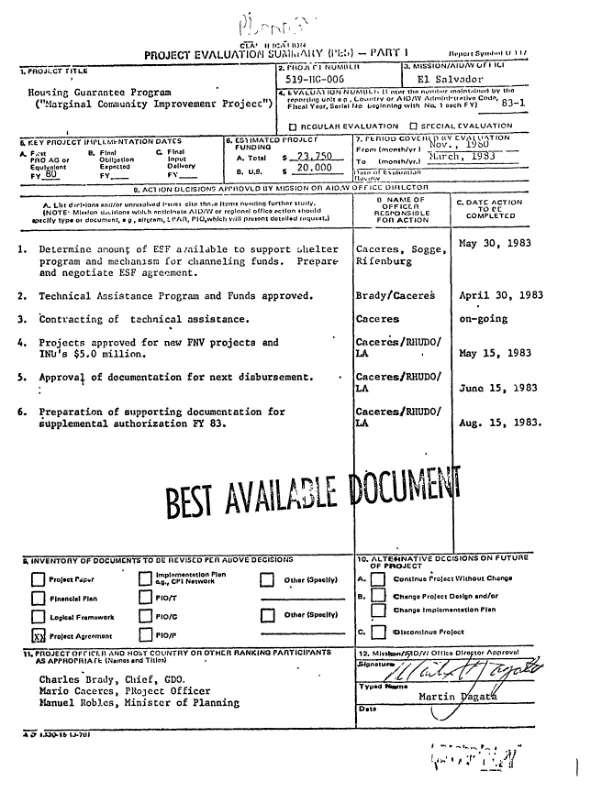
PES covers the period 11/80-3/83 and is based on document review, site visits, and discussions with personnel from USAID/ES and key housing and urban development institutions and with project beneficiaries. Progress has been slow. A decision was made in 1981 to reorient the loan program to the construction of new homes which, it was felt, could be completed more rapidly than housing renovation, the original project purpose. This reduced housing solution targets from 7,400 to 3,200. Nevertheless, and despite FY82 supplemental funding to construct additional units, only 2,118 units have been or are being constructed, and it is unlikely that the targeted number will be reached before the end of the project. The main problem has been that expectations for a fast disbursing loan program to finance construction have not been met. This problem of slow disbursements, which in the crisis atmosphere of El Salvador has been nearly intolerable, has dwarfed some genuine achievements (e.g., the savings and loan system is producing low-cost units and selling them at market prices for the first time in its history). The project"s problems have several causes. (1) Burdensome administrative procedures for the loan approval process often affect construction contracts. (2) The Urban Housing Institute (IVU) lacks liquidity to initiate new projects financed with FY82 supplemental funds, and the National Housing Fund (FNV) lacks the resources to provide complementary funding for private sector construction. (3) The focus on rapid disbursements has blurred the emphasis on low-cost housing strategies. Pressure has been put on A.I.D. to reassess income criteria and raise the loan ceiling so that higher-cost units can be funded - a move which is not justified at the present time. Additional financial constraints on the project include: (1) the Central Bank requirement that the terms of the dollar loan be passed directly to participating banks receiving colones; (2) much of the funding that is passed on from the FNV to IVU is done so at a rate unfavorable to FNV (which has actually lost money by participating in the HG); and (3) IVU"s maximum legal lending rate of 12% must be increased if IVU is to achieve a sound financial position. A key recommendation is that Economic Support Funds be made available to provide working capital for new construction.