USAID DEC
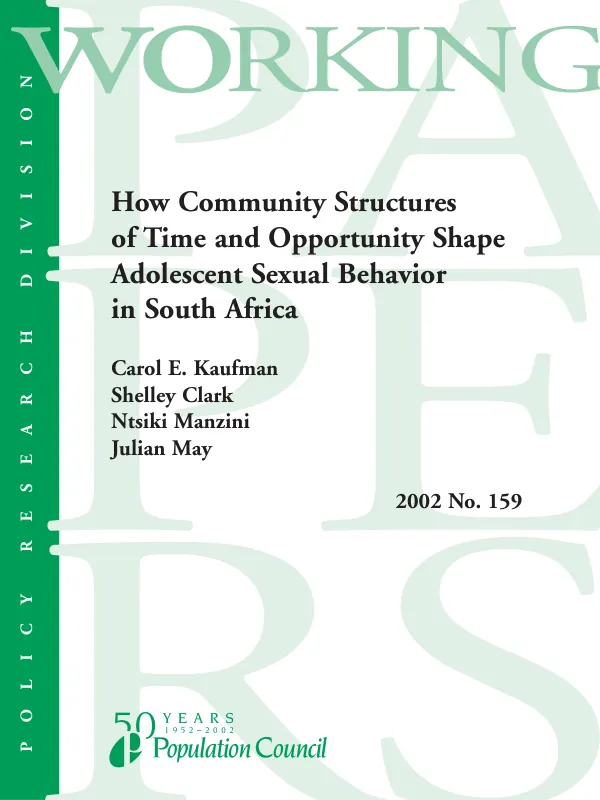
How community structures of time and opportunity shape adolescent sexual behavior in South Africa
Sign inPOPULATION COUNCIL
How community structures of time and opportunity shape adolescent sexual behavior in South Africa
Recently, South Africa has led the world in rates of HIV/AIDS infection.
Kaufman, Carol E.; Clark, Shelley · 1970
Sign in to readA free account is required to download.
Abstract
Particularly among young adults, the prevalence of HIV has soared, now reaching 25%. The statistics suggest a high level of unprotected sex and risky sexual behavior even in the midst of high levels of knowledge. Research has focused on the dynamics of individuals" and partners" sexual decision-making. Little is known, however, about the larger context in which those decisions are made. What are the everyday experiences that influence risk- taking? Are young people with little to do more likely to engage in risky behavior? Do community opportunities of schooling, work, and other activities make a difference? This study employs time- use data and data on education, work, and activities of adolescents collected from a representative sample of 2992 young people aged 14-22 living in Kwazulu-Natal, South Africa, to explore these questions. Analyses of time use indicate that African and Indian girls spend twice as much time engaged in unpaid domestic work as do their male counterparts, whereas White boys spend the most time of those studied in paid positions. Africans, both boys and girls, report studying fewer hours than other racial groups. For girls, levels of education in the community were positively associated with not having had sex in the last 12 months. Levels of wages in communities were positively associated with condom use for both boys and girls. Levels of sports activity in communities had a positive association with risk-taking among boys and a negative one among girls. (Author abstract)