USAID DEC
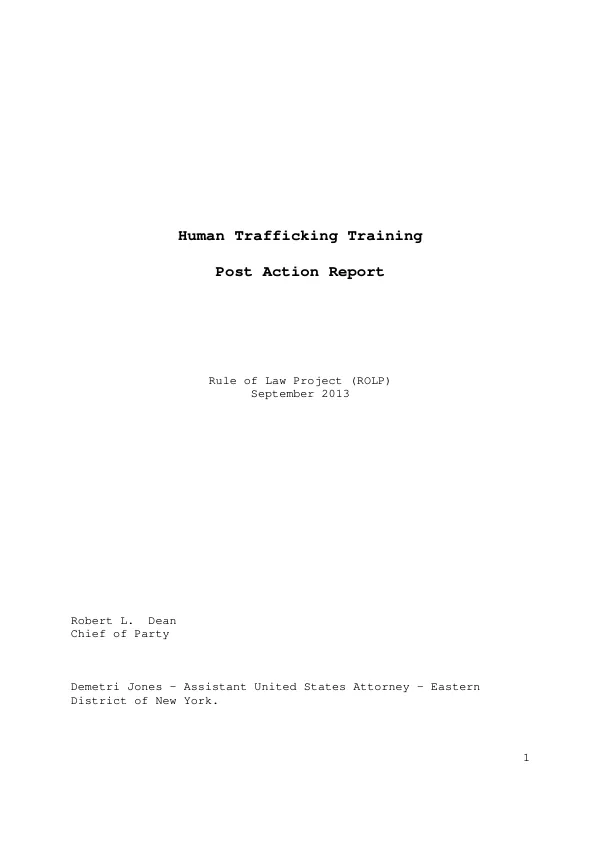
Human Trafficking Training - Post Activity Report - September 2013
Human trafficking training was conducted for Jordan's prosecutors in September 2013 as part of the Rule of Law Project (ROLP).
2013 · 9 pages
Sign in to readA free account is required to download.
Abstract
The training was led by Demetri M. Jones, an Assistant United States Attorney from the Eastern District of New York, who had extensive experience in investigating and prosecuting human trafficking cases. The training aimed to provide prosecutors with a basic understanding of international standards applicable to human trafficking, as well as the Jordanian law enacted in 2009. The training consisted of two sessions, each spanning two days, and was attended by approximately 40 prosecutors from various regions throughout Jordan. The goals of the training were to provide attendees with a basic overview of human trafficking and to present the victim-centered approach and task force model method of investigating and prosecuting human trafficking offenses. The training format included lectures, PowerPoint presentations, case studies of United States prosecutions, written material, and group discussions. The training covered specific topics such as the interpretation of the Jordanian anti-human trafficking law, investigative strategies, and victim-related issues. Discussion of the Jordanian law resulted in heated debate among the groups, with some attendees advocating for a literal interpretation of the law and others arguing for discretion to apply the spirit of the law. Attendees acknowledged that victims of trafficking who engage in illegal conduct during the course of the trafficking offense may have done so only as a result of their victimization. Attendees consistently recognized and raised legitimate issues that could prove detrimental to investigating and prosecuting human trafficking offenses. For example, they noted that although the law requires the creation of shelters for victims, only one such shelter exists to date. Additionally, attendees expressed concerns about obtaining foreign evidence that would be admissible in court and the deportation of immigrant victims before an investigation or prosecution could be completed. Based on the comments and questions asked by attendees, it appears that there is a lack of coordination between police and prosecutors, as well as a divide between police authority and prosecutor authority that is not allowing for joint efforts at investigating human trafficking offenses. Prosecutors either conduct their own separate victim interviews or rely solely on police interviews in developing cases, which can lead to issues such as victims being deported before the prosecutor has the opportunity to conduct an interview. It is recommended that prosecutors and police benefit from joint trainings to foster communication and coordination in investigating and prosecuting human trafficking cases. Use of prior Jordanian investigations and cases as training tools would allow both police and prosecutors to examine the results of those investigations and prosecutions to determine what strategies and techniques were successful or not successful. The attendees demonstrated a deep knowledge of the Jordanian anti-human trafficking law and an understanding of international concepts for handling human trafficking cases. Any future training programs should build upon the current knowledge level and expand to include joint training sessions with police using case studies from Jordanian investigations and prosecutions.
Related documents