USAID DEC
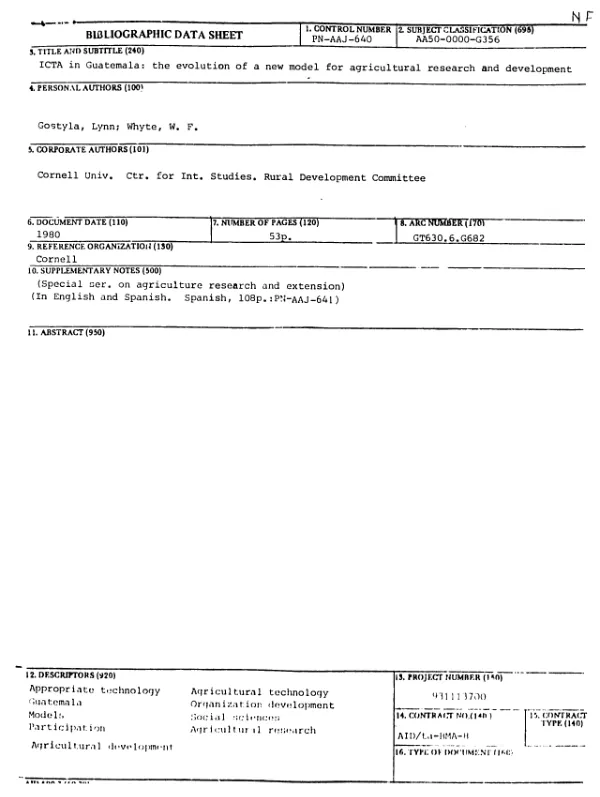
ICTA in Guatemala : the evolution of a new model for agricultural research and development
Sign inCORNELL UNIVERSITY. CENTER FOR INTERNATIONAL STUDIES
ICTA in Guatemala : the evolution of a new model for agricultural research and development
Agricultural research can have no impact upon small farmers" cultivation practices unless it addresses farmers" real problems and defines efficiency in farmers" terms.
Gostyla, Lynn; Whyte, William F. · 1970
Sign in to readA free account is required to download.
Abstract
Traditional research and development efforts - unilateral flows of initiative and information directed by national planners, executed by technicians through commodity programs, and imposed upon farmers - often result in production techniques that are rejected by small farmers. This report describes the development of Guatemala"s Institute of Agricultural Science and Technology (ICTA), which is dedicated to a decentralized research methodology designed to make research programs responsible for the adoption of appropriate agricultural techniques by including the contributions of farmers and social scientists. Under ICTA"s interdisciplinary research program, mainly developed by its Socio-Economic Unit (SEU), natural and social scientists survey farmers to identify homogeneous groups and their production constraints. The farmers then record their cultivation practices, supplying data about annual crop labor/resource investments. Experimentation with specific treatments, such as agronomic practices or crop varieties, is based on farmer information and the results of controlled tests at production centers. Using the farmers" traditional techniques, an agronomist and farmer test the selected treatments and then apply them to larger areas at different sites. In the next phase, the farmer tests the treatments alone; ICTA personnel visit to record information and conduct evaluations. Problems arose in the initial implementation of this approach, as technicians deprecated farmer input and SEU"s low-level regional presence was often erratic. The situation improved as technicians began to realize the benefits of farmer participation and as SEU sent adequate personnel into needed areas. The use of leadership farmers to monitor recordkeeping and test sites also has been helpful. An indication of the obstacles facing those introducing such innovations is provided in the authors" histories of ICTA and SEU, including the latter"s conflicts with external and internal proponents of traditional methods and relations with similar institutions.
Related documents