USAID DEC
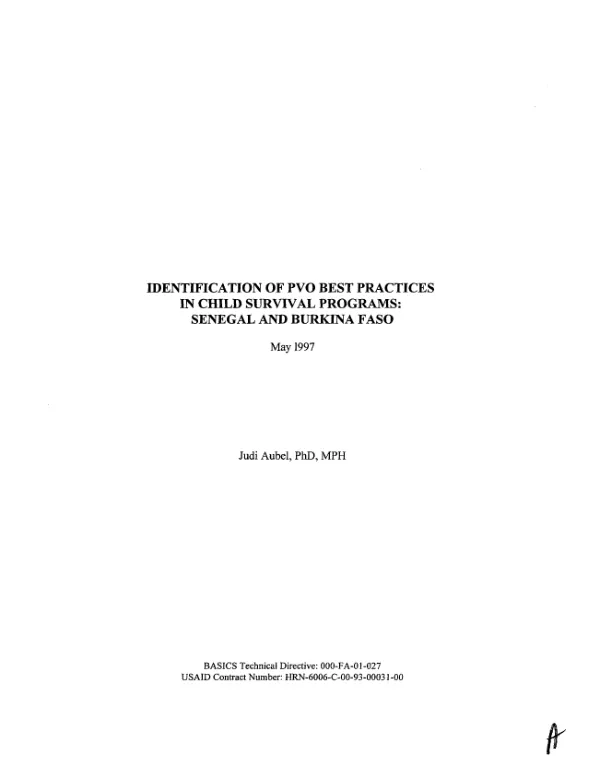
Identification of PVO best practices in child survival programs : Senegal and Burkina Faso
Sign inPARTNERSHIP FOR CHILD HEALTH CARE, INC.
Identification of PVO best practices in child survival programs : Senegal and Burkina Faso
Workshops were conducted in Senegal and Burkina Faso in April 1997 during which private voluntary organizations working in those countries shared their experiences in implementing child survival (CS) programs in collaboration with communities and ministries of health (MOH).
Aubel, Judi · 1997
Sign in to readA free account is required to download.
Abstract
Broad consensus on the need for strategies to elicit substantive community involvement, improve the quality of services at the health center level, and support district-level MOH teams led to the development of strategies for each of these levels. Efforts to identify tried and proven "best practices" were not very successful. Key community-level strategies included integrating CS into community development activities; involving various categories of community actors, including community leaders, men, older women, traditional healers, and women with young children; strengthening the ability of community organizations to develop and implement CS activities; training community actors and development technicians in community mobilization and problem-solving approaches; promoting participatory approaches to communication/health education; and involving teachers and students in promoting CS. The strategies developed at the workshop in Burkina Faso gave very little attention to health facility-level activities. The workshop in Senegal identified two important strategies for this level: (1) ensuring the quality of interpersonal communication and of the general ambiance in health centers, specifically during consultations; and (2) promoting the use of weaning paps made with local foods. Strategies targeted at district-level MOH teams included strengthening health worker skills in participatory approaches to working with communities and to promoting community health; and stimulating collaboration between health workers and development technicians from other sectors in CS efforts. The NGOs also identified their priority needs for TA in the above areas, as well as their lack of basic concepts and skills in the areas of community development and adult education/non-formal education, topics which have not been integrated into health school training programs and about which written documentation (in French) is extremely limited. A need was also expressed for simple tools for documenting, analyzing, or evaluating the implementation CS strategies and approaches. Includes recommendations.
Related documents
Documents in this collection
 1970
1970USAID DEC
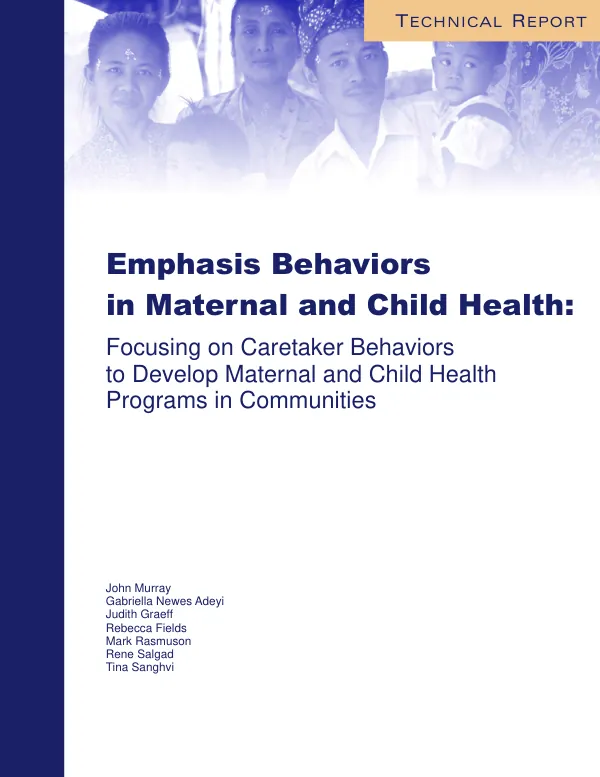
Emphasis behaviors in maternal and child health : focusing on caretaker behaviors to develop maternal and child health programs in communities
Open record![Sustainable ORS [oral rehydration solution] use in West Africa through private-public partnership : January 18-28, 1998, Abidjan, Cote d"Ivoire [and] Dakar, Senegal](https://covers.devme.ai/gen/47756.webp) 1998
1998USAID DEC
![Adaptation of infant and young child feeding recommendations for IMCI [integrated management of childhood illness] : Kazakhstan, and overview of adaptation process](https://covers.devme.ai/gen/45086.webp)