USAID DEC
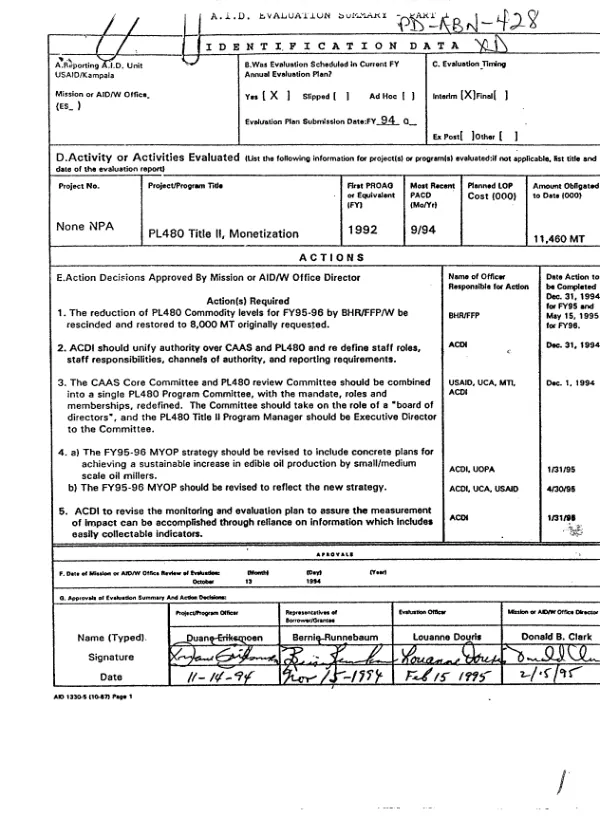
Impact evaluation and economic analysis of TechnoServe"s PL-480 Title II monetization program in Ghana
Sign inTECHNOSERVE, INC.
Impact evaluation and economic analysis of TechnoServe"s PL-480 Title II monetization program in Ghana
Evaluates three P.L.
Silverstein, Cathy; Herne, James G. · 1994
Sign in to readA free account is required to download.
Abstract
480 Title II programs implemented by TechnoServe/Ghana: (1) Farmer Service Cooperatives, which includes an inventory credit program to reduce postharvest losses and secure higher market prices; (2) Intermediate Technology Small-Scale Palm Oil Mills, to establish 60 community-based palm oil mills; and (3) nontraditional export development. Impact evaluation covers the period 1992-10/94. TechnoServe/Ghana"s overall program of rural, community-based, agricultural enterprise development has contributed significantly to enhancing the food security of local beneficiaries -- men and women alike -- at the household level, and has also had a positive economic impact at the community, regional, and national levels. The contribution of the Farmer Service Cooperatives program to household food security includes both increased availability of food for farmers and their families and increased access to food (particularly during the lean or "hungry" season) via the increased income earned through the inventory credit program. The cooperatives also contribute to better utilization of Ghana"s food resources by assisting farmers with postharvest storage and marketing. Particularly impressive is the impact of the inventory credit program on farmers in Ghana"s Upper West Region, located in the southern Sahel, which has only one crop season per year and is among Ghana"s most food-insecure regions. Farmers assisted by TechnoServe have much greater food security than do non-participating farmers, and they have also experienced significant income increases as a result of the program. TechnoServe/Ghana"s other programs are located in the central and southern sections of the country, where food insecurity occurs through variability in rainfall patterns and the resultant periodic crop failures. The impact on food security of TechnoServe"s assistance comes mainly through increased household incomes, which enable farm families to purchase food during the lean season. The palm oil mill program has improved local processing of palm fruit and has introduced handy 20-liter containers which greatly facilitate storage and transport of palm oil. These contributions have been particularly beneficial to rural women. Moreover, a cost-effectiveness analysis of the program -- using very conservative projections for processing volumes and sales revenue -- reveals that it will provide approximately $10 in economic benefits for $1 of direct TA costs. The anticipated introduction of a palm oil inventory credit program in 1994/95 will likely further increase farmer/processor incomes. While the non-traditional export program only began in 7/93, it is apparent that participants will achieve enhanced food security, as cashews, one of the main crops targeted, are harvested and sold during the lean season, providing cash income to the farmers at the time of greatest need. With its focus on demonstrating the economic value of tree crops, this program also has potential for significant environmental impact. The evaluation team recommends that USAID approve TechnoServe"s FY 1995-1997 Multi-Year Operating Plan and expand the Upper West Farmer Service Cooperatives program. (Author abstract, modified)
![ADRA/Ghana's food security program (PL 480 Title II) : FFP-A-00-02-00015-0 [i.e. FFP-A-00-02-00015-00] -- FY 2002-FY-2006 : impact evaluation -- final report](https://covers.devme.ai/gen/4731.webp)