USAID DEC
Impact evaluation of mandatory protection measures on domestic violence : evaluation society in Bosnia and Herzegovina
Sign inIMPAQ INTERNATIONAL, LLC
Impact evaluation of mandatory protection measures on domestic violence : evaluation society in Bosnia and Herzegovina
In the Federation of Bosnia and Herzegovina (FBiH), the Law on Protection against Domestic Violence provides for immediate protection of victims.
Kovač, Rijad; Hrnčić, Zlatan +5 more · 2018
Sign in to readA free account is required to download.
Abstract
An assessment of the impact of domestic violence protection measures in FBiH has been the purpose of this study. This evaluation brought together monthly data for the years 2013 through 2017, together with interviews with victims and main stakeholders. The field research was conducted in cooperation with the professional staff of social work centers. The administrative data on reported cases, as well as survey data for the cases of 647 victims from the Sarajevo Canton have been collected in the panel database. We also analyzed the implementation of protective measures and their effectiveness and efficiency on the reported cases. To analyze the impact, the logit model was estimated and we also estimated and reported marginal effects. We also applied the dynamic random effects probit to complement the results. Within the model, the initial condition was addressed following the approach of Wooldridge (2005), 1 who modeled an unobserved heterogeneity by including the values of time-varying explanatory variables in each period in the model. The main results reveal the impact of our main variables of interest, that is the protective measure. Three of protective measures, harassment or stalking the victim of violence, psychological treatment as well as arrest, and any prior imposition of these measures reduces predicted probability of domestic violence in the future. Also, the victims’ age is slightly associated with the risk of violence, with older victims being related with higher incidence of violence. The place of residence also emerges as a significant predictor of domestic violence, where those residing in rural areas are more likely to experience violence than those who reside in urban areas. Finally, witnessing violence during childhood, for both the victims and the perpetrators, does not seem to influence their experiencing violence in later relationships. At the same time, presence of children does positively impacton the domestic violence. As expected, alcohol abuse of perpetrators is linked with a higher likelihood to commit domestic violence. Taking into account the above findings, this study provides a broad range of recommendations, with the key focus on prevention by means of mandated psychological treatment, which produces the strongest long-term impact.
Related documents
Documents in this collection
 2016
2016USAID DEC
Strengthening civil society"s legitimacy, competence, and professionalism and increasing its influence on public policies in Bosnia and Herzegovina : performance evaluation of USAID/BiH civil society sustainability project (CSSP)
Open record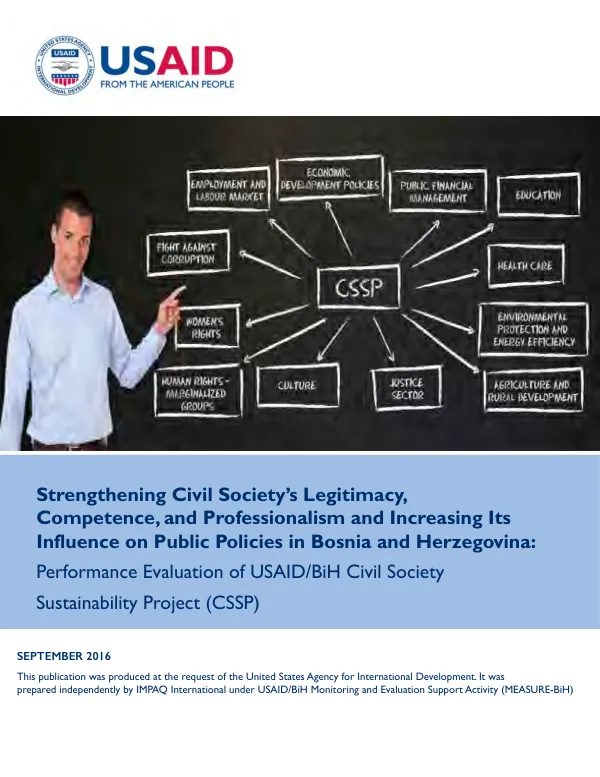 2016
2016USAID DEC