USAID. MISSION TO ZAIRE
Impact evaluation of project Nord Shaba
Evaluates project to improve corn production and marketing in Zaire's North Shaba region as well as improve the level of commercial activity and social and institutional development.
Poulin, Roger|Appleby, Gordon|Quan, Cao · 1987
Sign in to readA free account is required to download.
Abstract
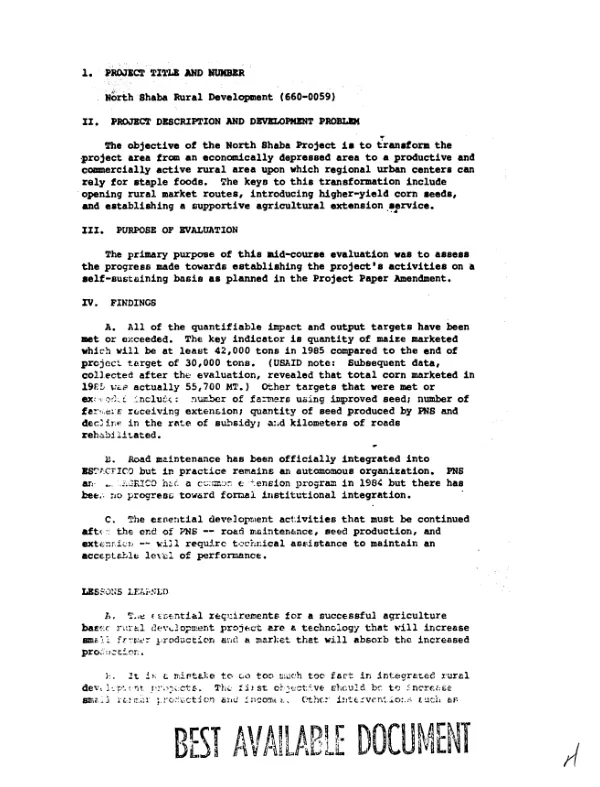
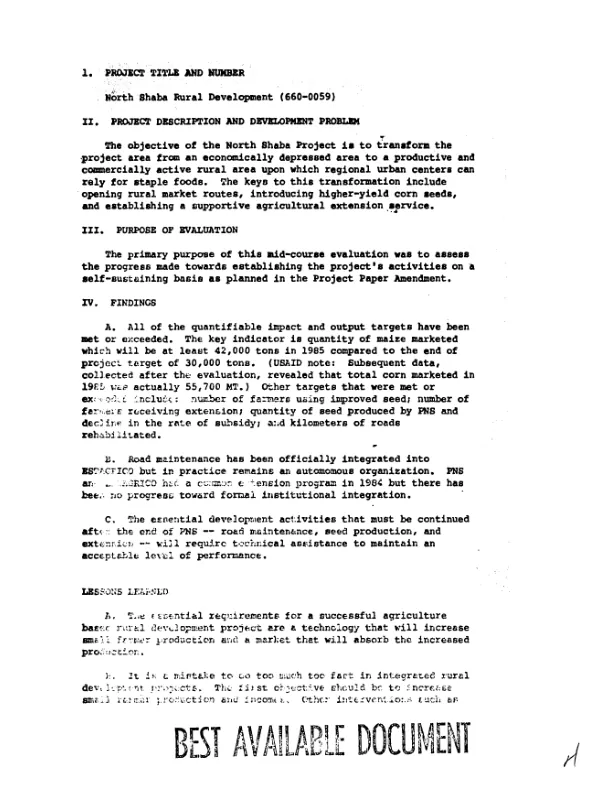
Final impact evaluation covers the period 10/78-1/87. Corn production and marketing in North Shaba benefitted greatly from project activities. Production is estimated to have increased from about 30,000 MT in 1977/78 to about 90,000 MT in 1985/86. During this same period, the quantity of corn shipped by rail from North Shaba increased from about 12,000 MT to about 50,000 MT, or almost half of all the corn marketed in Shaba. While other changes in local conditions contributed to increased production from 1978 to 1981, project interventions were more directly responsible for increases in yields from 1982 onward. Demonstration plots show that Kasai I results in a 40% yield increase and the recommended improved practices account for an additional 30%, totaling a cumulative 80% increase over traditional farming. Nonetheless, there are definite differences in the impact of the project on the two target zones, Kongolo and Nyunzu, as corn marketing increased by a far greater percentage in Kongolo. In addition, consumption in Kongolo, where corn was and remains a staple, seems to have tripled. Income generated from the marketing of corn also varies greatly between the two regions with more dramatic increases in Nyunzu where the top 50% of farmers earn more than even the largest farmers in Kongolo. These changes, however, are not large in terms of total income generated. Further, the resulting increases in commercial activity, although significant in relative terms, were correspondingly small. The effect was to increase the level of economic activity in the two major centers by a factor of two or three, and to create a noticeable level of commercial activity in the secondary centers (i.e., Mbulula, Sola, Lengwe) where almost none existed previously. In terms of social services, more children are going to school in Kongolo and there are more pharmacies, but there has, in fact, been almost no social or institutional development as a result of the project. The level of economic activity, both per household and in the aggregate, is not yet large enough to support this type of change. The project taught: the value of using project farmers as extensionists and the value of multiple cropping for increasing farm income; that adaptive testing adds flexibility to technical packages; that contract farmers can produce seed at much lower cost than the mechanized farm at Ngaba; and that demand for open pollinated varieties can be easily overestimated. A key sustainability issue is whether or not and to what extent road repairs are needed to ensure the evacuation of corn in some of the project areas.
Related documents