CREATIVE ASSOCIATES INTERNATIONAL, INC. (CAII)
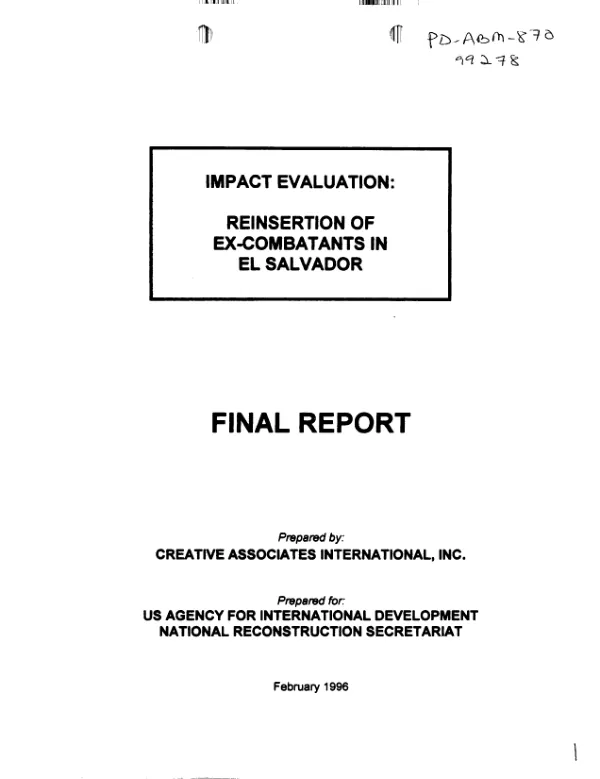
Impact evaluation : reinsertion of ex-combatants in El Salvador -- final report
Evaluates as of 11/95 the impact of USAID's efforts to support the social and economic reintegration of ex-combatants in El Salvador following the Chapultepec Peace Accords of 1/16/92.
Votaw, Susan|Fabre, Marcelo · 1996
Sign in to readA free account is required to download.
Abstract
The evaluation was conducted by Creative Associates, Inc., which itself participates in reintegration efforts under a contract with USAID. Both subjective and objective measures indicate that ex-combatants have indeed been reintegrated into society: some 80% of respondents in the evaluation sample consider themselves to be reintegrated, and respondents' median scores on a `reinsertion index' of social and economic indicators were within the same range as the scores for civilians. The only group not reintegrated according to the index are those who received no benefits. According to respondents, civil options, skills development, and taking advantage of benefits were the three principal contributors to reintegration. The more respondents consider themselves reintegrated, the more they value civil options and skills development, as opposed to demanding rights or relying on benefits programming. Further, ex-combatants are increasingly involved in their communities (a key indicator of social reinsertion). They believe that: reinsertion programming was highly important in their reintegration, they themselves played a key role in selecting their benefits, and the international community is responsible for the availability of their benefits. Conversely, ex-combatants do not recognize the sizable role played by the Government of El Salvador in creating and delivering their reinsertion benefits. While no group was fully satisfied with the menu of available reinsertion programming options, benefits were generally considered appropriate and useful to reinsertion. Lessons learned are as follows. (1) Much has been done to support the war-to-peace transition in El Salvador, much of it geared specifically for ex-combatants. In particular, local and international financial support for reinsertion programming was tremendous. (2) Reinsertion programming offered broad coverage to those who served in the 12 years of conflict, with a varied menu of choices. (3) Reinsertion involves many changes in status, behavior, and self-definition. (4) The number of benefits accessed has no direct impact on reinsertion, though beneficiaries tend to value what they received. (5) Period of military service has no direct correlation with level of reinsertion. (6) While level of formal education has a slight impact on ex-combatants' degree of reinsertion, reinsertion programming masks the educational requirements for civilian performance. (7) Income is the single most important factor in successful reinsertion. (8) Benefit tracks were able to accommodate many but not all ex-combatants -- the tens of thousands of demobilized represented too large and varied a population to be accommodated in full by three tracks of benefits. (9) Practitioners and ex-combatants did not understand reinsertion in the same way. (10) Reinsertion programming may have crossed the efficiency curve whereby benefits no longer outweigh costs. (11) The impact of programming begins with design. Specific impacts should be planned and defined up front so that programming may be specifically geared to fulfilling those goals. Recommendations are that: reinsertion goals and scope be clearly defined at the outset; reinsertion programming model civilian life and stress performance; reinsertion programs be based on a thorough knowledge of the target populations and their needs and include specific measures to address identified barriers to reinsertion; and benefit tracks be kept flexible and allow the demobilized to change options. Finally, it is recommended that reinsertion programming: be specifically linked to opportunities for income generation; include training in decision making; guarantee equal value of benefits (which is not the same as equal benefits for all populations); wherever possible, reward superior performance; be demand-driven; and include counseling to help ex-combatants develop realistic expectations. (Author abstract, modified)
![Annex IV : mid-term evaluation of the national reconstruction project support for transition to peace in El Salvador (no. 519-0394) (CLUSA [Cooperative League of the USA])](https://covers.devme.ai/gen/6653.webp)