USAID DEC
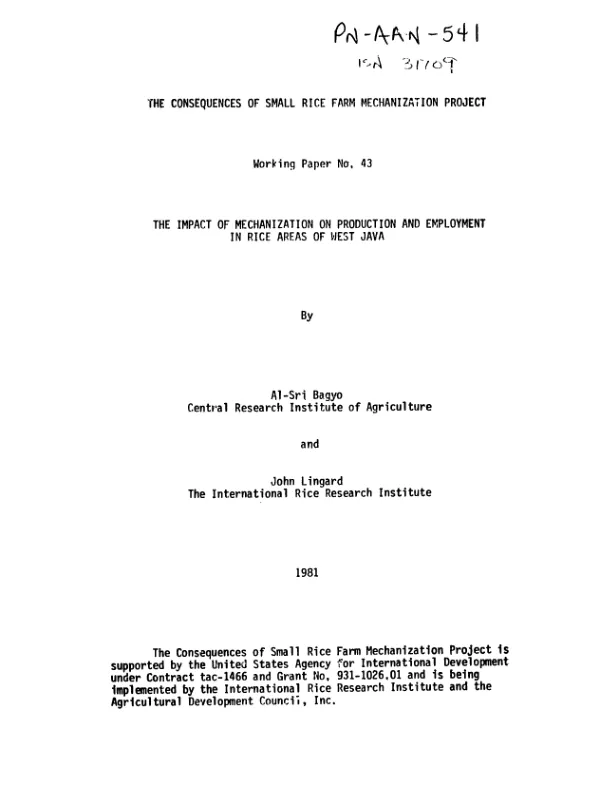
Impact of agricultural mechanization on production and employment in rice areas of West Java
Sign inAGRICULTURAL DEVELOPMENT COUNCIL, INC.
Impact of agricultural mechanization on production and employment in rice areas of West Java
The effects of farm mechanization on production and rural employment in the rice areas of West Java are analyzed, using a large data set and three different methods.
Bagyo, Al S.; Lingard, John · 1983
Sign in to readA free account is required to download.
Abstract
First a t-test was conducted to compare input use, labor use, cropping intensity, farm size, and output on mechanized and nonmechanized farms; results showed that mechanized farms (which tend to be about three times larger than nonmechanized farms) use more fertilizer, less pesticide, and less labor per ha and obtain higher yields, but have a lower cropping intensity. Next, decomposition analysis showed that farm size was the most important factor contributing to the difference in total output between the two types of farms, while yield and cropping intensity had only minor effects; area farmed was also the strongest explicator of total labor use. Regression analysis was then used to further determine whether yield differences were mainly due to mechanization or to other factors. Results again demonstrated that farm size and fertilizer were the most important factors; mechanization dummies were small and insignificant while pesticide use was both significant and negative. Results confirm the importance of fertilizers in explaining yield differences between different categories of rice farms. They further suggest that mechanization of farms currently using manual labor could result in major job displacement and should be guarded against unless there are significant yield or cropping intensity increases. (Author abstract, modified)